 Gareth Wilson
Evaluating Webhook Fan-out Services to Distribute Events at Scale
When a single event needs to trigger multiple downstream processes, webhook fan-out becomes essential. Whether you're notifying Slack about a deployment, updating your analytics platform, and kicking off a CI/CD pipeline (all from one GitHub push), fan-out architecture makes it possible without building complex routing logic yourself.
What Is Webhook Fan-out?
Fan-out is an architectural pattern where a single incoming message gets distributed to multiple independent consumers. In the context of webhooks, this means one event from a source system (like Stripe, GitHub, or Shopify can be delivered to several destinations simultaneously. Consider a practical scenario: an e-commerce platform receives a webhook when an order is placed. That single event might need to reach your inventory system, email service, analytics dashboard, and accounting software. Without fan-out, you'd either build custom routing logic or have each service poll for updates. Neither approach scales well.
The fan-out pattern provides three key benefits:
- Decoupling - destinations don't know about each other
- Parallelism - all deliveries happen concurrently
- Resilience - one failing destination doesn't block others
Common Use Cases
Development teams frequently use fan-out for CI/CD orchestration. A single push to a repository can trigger test runners, deployment pipelines, and notification systems simultaneously.
Operations teams route monitoring alerts to multiple channels where they create incidents in PagerDuty while posting to Slack and updating status pages, all from one alert webhook.
Product teams distribute customer events across their stack. A signup event might update the CRM, trigger a welcome email sequence, increment analytics counters, and notify the sales team, with each system receiving the same event independently.
How Fan-out Works
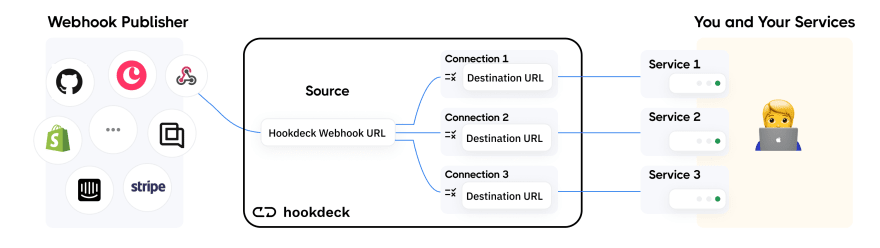
The mechanics are straightforward. A fan-out service sits between event sources and your destinations, acting as an intelligent router.
First, the service provides you with a single, persistent URL (your webhook endpoint). You register this URL with your event source (Stripe, GitHub, etc.). When an event fires, it hits this single endpoint rather than requiring you to manage multiple URLs at the source.
Next, the service copies the incoming event and delivers it to all configured destinations. Each delivery is independent, so if your Slack notification fails, your database update still proceeds. The service typically handles retries, logging, and delivery confirmation for each destination separately.
Finally, most services allow filtering. Not every destination needs every event. You might want payment failures sent to PagerDuty but successful payments only logged to your data warehouse. Filtering rules let you route specific event types to specific destinations.
Key Features in Webhook Fan-out Services
When evaluating webhook fan-out services, several capabilities distinguish capable solutions from basic proxies.
Reliable delivery with retries matters most. Webhooks operate on "at-least-once" delivery semantics, meaning failures happen. Your fan-out service should automatically retry failed deliveries with configurable backoff strategies, and provide visibility into delivery status.
Filtering and transformation allow you to route events intelligently. Look for services that let you write rules based on event payload content, not just event type. Some services also transform payloads, which is useful when destinations expect different data formats.
Observability and debugging become critical at scale. You need logs of every incoming event and outgoing delivery, the ability to replay failed events, and metrics on latency and success rates. When something breaks at 2AM, these tools can be the difference between debugging for minutes or hours.
Idempotency support helps destinations handle duplicate deliveries gracefully. Services that pass through unique event identifiers (or generate them) make it easier to deduplicate on the receiving end.
Performance and scalability should be transparent. Understand the service's latency characteristics and throughput limits. Fan-out adds a hop between source and destination, so it's important that this overhead is minimal and predictable.
How Hookdeck Handles Fan-out
Hookdeck approaches fan-out with an event gateway model. You create a Source (your webhook endpoint URL), then define Connections that link that Source to multiple Destinations.
Each Connection can have its own filtering rules, retry policies, and transformation logic. This means one incoming webhook can fan out differently based on its content. For instance, a payment event might go to three destinations while refund events go to five.
For implementation details and step-by-step guidance on setting up fan-out with Hookdeck, see the docs: How to Fan Out Webhooks to Different Services.
Getting Started
If you're currently routing webhooks manually or maintaining multiple endpoint registrations with each provider, fan-out services can dramatically simplify your architecture. Start by mapping your current webhook flows: which sources send events, which destinations consume them, and what routing logic exists today.
Hookdeck offers a free tier suitable for testing and low-volume use cases, and affordable pricing for those with more critical needs. The investment in setup quickly pays off in reduced maintenance burden and improved reliability.