 Gareth Wilson
Hookdeck Outpost vs Convoy: Webhook Sending Compared
Sending a few webhooks is simple. But as your customers begin to rely on them, you need to start thinking about delivery guarantees and retry mechanisms, multi-tenancy, subscriptions, and user portals. Hookdeck's Outpost ensures you can send webhooks reliably without building a custom solution.
If you're adding webhook delivery into your product, Hookdeck Outpost and Convoy are two platforms worth evaluating. Both let you send webhooks to your customers reliably, but they take different approaches: Outpost is a focused, cost-effective event delivery service with native multi-destination support and full open-source parity, while Convoy is a unified webhook gateway that bundles sending and receiving into a single product built on a PostgreSQL-backed control and data plane architecture.
This comparison breaks down the meaningful differences so you can decide which trade-offs make sense for your product.
At a glance
Both products handle outbound webhook delivery with retries, customer portals, and multi-tenancy. Outpost and Convoy are close in feature surface. The differences are in destination types, observability, portal customization, and pricing.
| Capability | Hookdeck Outpost | Convoy |
|---|---|---|
| Destination types | Webhooks, SQS, S3, ServiceBus, Pub/Sub, RabbitMQ, EventBridge, Kinesis, Kafka, Cloudflare Queues — all native | Webhooks only (ingests from brokers but delivers to HTTP only) |
| Deployment | Hosted SaaS + self-hosted (Apache 2.0, full parity) | Hosted SaaS + self-hosted (Elastic License 2.0) |
| Customer portal | White-label React SPA with full theming + custom UI API | Portal Links; white-labelling on self-hosted Premium only |
| Observability | Metrics dashboard, OpenTelemetry support on all tiers | Prometheus queue and ingestion metrics |
| Data retention | 7 days (Starter), 30 days (Growth) | 7 days (Pro), Custom (Enterprise) |
| Rate limits | Uncapped | Fixed per plan (not published) |
| Retries | Automatic exponential backoff, manual retry, custom | Automatic exponential backoff + manual retry |
| Security | Signatures, rotation, idempotency headers, timestamps | Signatures, rolling secrets, idempotency headers, timestamps |
| IP blacklisting | - | Yes |
| Throttling | - | Via environment variable |
| Per-event cost | $10/million | Not documented |
| Uptime SLA | 99.99% (Growth), 99.999% (Enterprise) | 99.99% (Pro), 99.999% (Enterprise) |
| Compliance | SOC 2 Type II, HIPAA, GDPR, CCPA, PIPEDA | SOC 2 Type II, GDPR |
| Data residency | US, EU, Asia | US, EU |
| Paid plans from | Pay-as-you-go ($10/million events) | $99/mo (Pro) |
| Free tier | Self-hosted (unlimited) + 50K managed events free | Self-hosted (free); no free cloud tier |
The Outpost approach
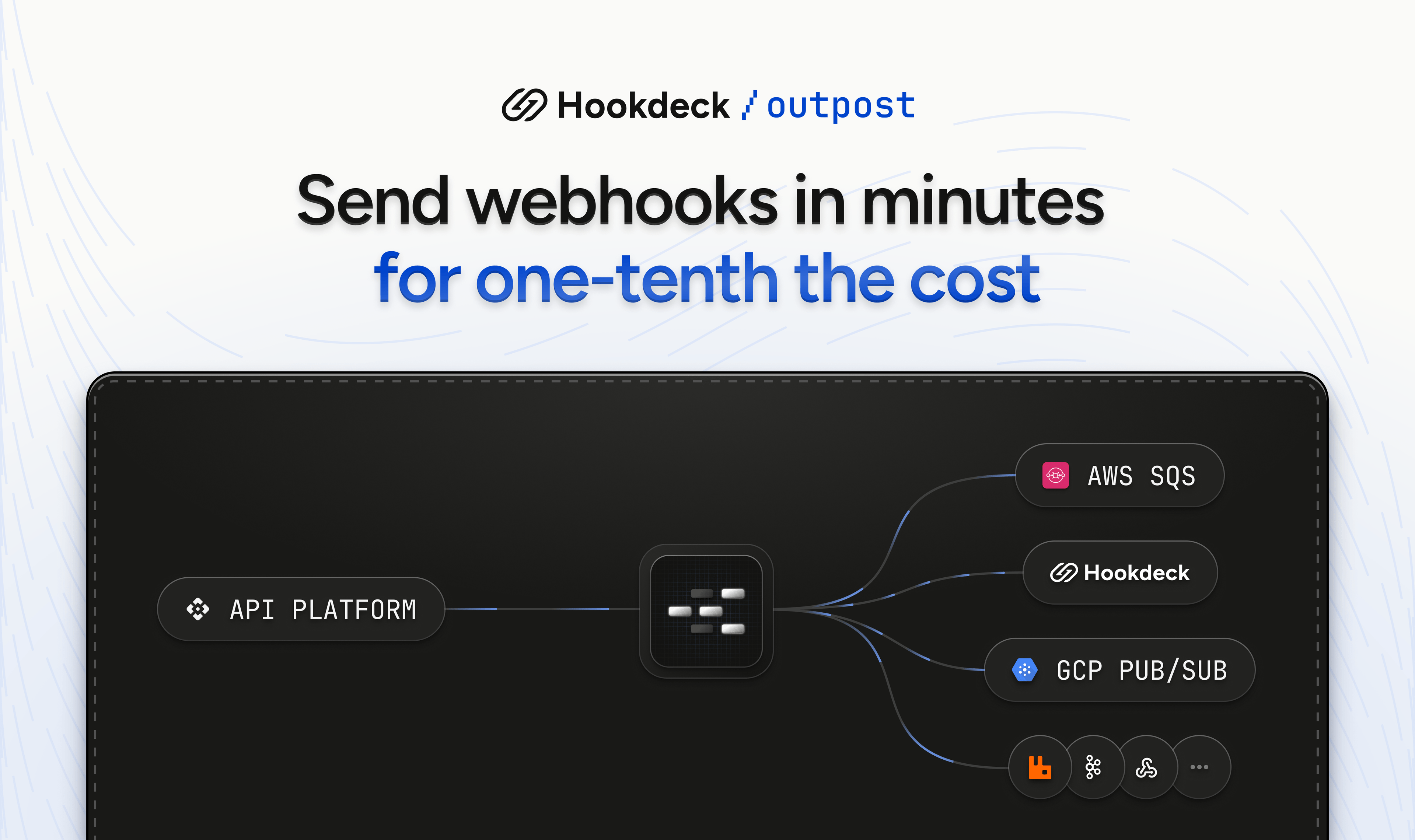
Before looking at individual features, it's worth understanding the product philosophy behind Outpost. It's intentionally focused: providing the essentials for reliable, multi-destination event delivery with an exceptional developer experience, without the bells and whistles that drive up cost.
Convoy takes a different approach: a unified gateway for both sending and receiving, built on a PostgreSQL-backed architecture. This gives it self-hosted flexibility but means it relies on PostgreSQL for queueing and persistence rather than purpose-built infrastructure.
Outpost and Convoy share a similar feature footprint for outbound delivery. The differences come down to where your customers' events need to go, how much visibility you need into the delivery lifecycle, and how your portal looks.
Pricing and rate limits
Hookdeck Outpost pricing is $10 per million events on a pay-as-you-go basis with no per-second rate cap at any tier. The self-hosted version is free with no usage limits. The managed service includes a free tier of 50,000 events/month. The Starter tier is pure pay-as-you-go with no monthly minimum; the Growth tier at $499/mo adds SLAs and SSO.
Convoy Cloud starts at $99/mo flat for the Pro plan, and Cloud Premium is $499/mo. Each plan has a fixed throughput limit, but Convoy doesn't publish the figures. Enterprise pricing is custom. There is no free cloud tier beyond a 14-day trial, though the self-hosted Community edition is free and self-hosted Premium is $999/mo.
Outpost's usage-based pricing scales transparently in both directions: low-volume teams pay very little, and high-volume teams pay a predictable per-event rate with no throughput ceiling. Convoy's $99/mo flat fee is straightforward, but each plan's throughput limit could become a bottleneck for bursty workloads, and because Convoy doesn't publish those limits, capacity planning is harder at scale.
Convoy does include Google SSO at the $99/mo Pro tier (SAML SSO starts at Cloud Premium, $499/mo), while Outpost requires the $499/mo Growth plan for SSO, a meaningful difference if Google SSO covers your requirement at a lower budget.
Destination types
This is Outpost's most significant functional differentiator.
Hookdeck Outpost natively supports delivering events to webhooks (HTTP endpoints), AWS SQS, S3, ServiceBus, GCP Pub/Sub, RabbitMQ, EventBridge, Kinesis, Kafka, Cloudflare Queues, and Hookdeck Event Gateway event destinations. All 11 destination types are available on every tier, including the self-hosted version, with no add-ons or additional components.
Convoy delivers to HTTP webhook endpoints only. Convoy can ingest events from GCP Pub/Sub, Kafka, AWS SQS, and RabbitMQ, but delivery is always to an HTTP endpoint. There is no way to deliver events to a customer's SQS queue, Kafka topic, or S3 bucket.
This is a fundamental architectural difference. If your customers want events delivered to their own infrastructure — SQS queues, Pub/Sub subscriptions, S3 buckets, EventBridge, or Kafka topics — Outpost handles that natively with the same API and portal. Convoy can't deliver there at all, regardless of tier.
Deployment and open source
Both products offer self-hosted deployment, but the licensing and parity differ.
Hookdeck Outpost is available under Apache 2.0 with full feature parity between the self-hosted and managed versions: same codebase, same capabilities. It deploys as a single binary or Docker container with horizontal scaling support, and is designed as a backward-compatible drop-in alongside existing webhook implementations.
Convoy is source-available under the Elastic License 2.0 and can be self-hosted. The free Community edition covers incoming and outgoing webhooks, retries, and message broker support; circuit breaking, RBAC, portal links, and OpenTelemetry export need the $999/mo self-hosted Premium license. The architecture uses a control and data plane built on PostgreSQL.
Both products offer genuine self-hosted options, a strength they share compared to some competitors. The key difference is architectural: Outpost is a serverless managed service that also ships as a self-contained binary, while Convoy requires PostgreSQL infrastructure for its control and data plane. If you're already running PostgreSQL, Convoy fits naturally. If you want a simpler deployment footprint, Outpost's single binary approach has less operational overhead.
Customer portal
Both products offer a user portal, but the customization depth differs significantly.
Hookdeck Outpost provides a white-label React SPA with full theming: light/dark mode, custom logo, accent color, and complete branding removal. Beyond the embeddable portal, Outpost also offers a full API with API key and JWT authentication for building entirely custom portal UIs. So if the embeddable component doesn't fit your product's design system, you can build your own.
Convoy offers a customer portal through Portal Links on Cloud Pro and self-hosted Premium. White-labelling is listed only on the $999/mo self-hosted Premium license, not on Convoy Cloud plans. Convoy provides an API but no documented support for building custom portal UIs.
If your webhook portal is customer-facing and branding matters to your product experience, the gap here is significant. Outpost gives you a fully themed embedded portal or the API to build your own. Unless you self-host Convoy's Premium license, its portal will look like Convoy's portal inside your product.
Observability
Hookdeck Outpost includes OpenTelemetry support (traces, metrics, and logs) on all tiers, including the self-hosted version. You get full delivery lifecycle visibility from day one: which events were sent, when, to where, whether they succeeded or failed, and how long they took.
Convoy provides Prometheus metrics for queue and data ingestion. This gives you operational metrics on system health, but doesn't provide the structured per-event telemetry that OpenTelemetry delivers: no traces, no per-delivery logs, no integration with observability platforms like Datadog, Grafana, or Honeycomb.
If you're building a production webhook delivery system and need to debug delivery failures, understand latency distributions, or integrate with your existing observability stack, Outpost's OpenTelemetry support is a meaningful advantage. Convoy's Prometheus metrics tell you the system is running but give less visibility into individual delivery outcomes.
Data retention
Hookdeck Outpost retains delivery data for 7 days on the Starter tier, 30 days on the Growth tier, and custom retention on Enterprise.
Convoy retains data for 7 days on the Pro plan ($99/mo), with custom retention available on Enterprise.
At the entry-level paid tiers, retention is equivalent, both offering 7 days. On the Growth tier, Outpost provides 4x longer retention at 30 days, which gives you a larger window for debugging delivery issues and meeting compliance or audit requirements. Enterprise plans on both platforms offer custom retention.
Retries and reliability
Hookdeck Outpost provides automatic retries with exponential backoff and manual retry via the API and portal. Circuit breaking automatically detects unhealthy endpoints and stops sending to them, resuming delivery once the endpoint recovers. Destinations are auto-disabled after consecutive failures. Retry customization is flexible, and users can set custom retry schedules.
Convoy also provides automatic retries with exponential backoff and manual retry for failed deliveries. Circuit breaking is supported.
The core retry and circuit-breaking functionality is comparable. Both products handle the fundamental reliability requirements for webhook delivery.
Security
Hookdeck Outpost provides webhook signatures with signature rotation support, idempotency headers, and timestamps for replay protection.
Convoy provides webhook signatures with rolling secrets, idempotency headers, and timestamps. Convoy also includes IP blacklisting for SSRF prevention.
The security capabilities are similar at the core: both support signing, secret rotation, idempotency, and timestamps. Convoy's IP blacklisting is an additional layer for preventing SSRF attacks on outbound delivery, which Outpost doesn't offer. Convoy also supports API key and OAuth authentication, while Outpost uses JWT and API key.
Event topics and filtering
Hookdeck Outpost supports topic-based subscriptions with content-based filtering, allowing your customers to subscribe to specific event types and filter based on event content.
Convoy offers event types with filtering, plus destination filters.
Both products let customers subscribe to the event types they care about and filter on content. The implementations are comparable for most use cases.
Multi-tenancy
Hookdeck Outpost provides native tenant isolation, keeping each of your customers' webhook configurations, delivery history, and endpoints separated.
Convoy uses a native projects/organizations model that similarly isolates customer data.
Both products are designed for multi-tenant SaaS use cases. The approaches differ in naming and structure, but the outcome (clean tenant isolation) is the same.
What Convoy offers that Outpost doesn't
Convoy's feature differences are few, but worth noting:
IP blacklisting: Convoy includes IP blacklisting for SSRF prevention on outbound delivery. Outpost does not support this.
Throttling: Convoy supports throttling configuration via environment variable. Outpost doesn't expose throttling controls.
Authentication types: Convoy supports OAuth authentication in addition to API key. Outpost uses JWT and API key.
SSO at a lower price: Convoy includes Google SSO at the $99/mo Pro tier; SAML SSO starts at Cloud Premium ($499/mo). Outpost requires the $499/mo Growth plan for SSO.
These could be real advantages for specific use cases, but for many teams won't justify the significant price premium. The products are similar in scope, and Outpost wins on destination types, observability, portal customization, and pricing transparency.
Compliance and data residency
Hookdeck holds SOC 2 Type II, HIPAA, GDPR, CCPA, and PIPEDA certifications, and signs Business Associate Agreements (BAAs) for customers who need them. Outpost is currently hosted in the US, EU and Asia (Singapore).
Convoy similarly holds SOC 2 Type II and GDPR certifications, but only offers hosting in EU and the US.
Uptime SLAs
Hookdeck Outpost offers a 99.99% uptime SLA on the Growth tier and 99.999% on Enterprise.
Convoy offers 99.99% on Pro and 99.999% on Enterprise.
Both platforms offer comparable uptime SLAs at equivalent tiers: 99.99% on their mid-tier plans and 99.999% on Enterprise.
When to choose Hookdeck Outpost
Outpost is the stronger choice when your customers need events delivered to destinations beyond HTTP webhooks (SQS, Pub/Sub, RabbitMQ, S3, EventBridge, Kinesis, Kafka, Cloudflare Queues, etc.), when you need OpenTelemetry observability for the delivery lifecycle, when portal branding and customization matter to your product experience, when cost transparency matters (pay-as-you-go with uncapped rate limits), hosting in Asia, or when you want a self-hosted option with full feature parity.
When to choose Convoy
Convoy may be the right choice if you need both sending and receiving in a single unified gateway, if self-hosted deployment on your own PostgreSQL infrastructure is a priority and you're comfortable with the operational overhead, if Google SSO at a $99/mo price point is a hard requirement, if IP blacklisting for SSRF prevention is important, or if OAuth authentication (rather than JWT/API key) is needed for your integration.
Conclusion
Hookdeck Outpost and Convoy are close in feature surface. The meaningful differences are in destination flexibility, observability, and portal quality. Outpost delivers events to 11 destination types natively (not just HTTP), includes OpenTelemetry on every tier, and provides a fully customizable white-label portal with a custom UI API, all on transparent, usage-based pricing.
For teams that need to deliver events beyond HTTP endpoints, want deep observability, or value portal customization, Outpost is the more capable choice. For teams that want a self-hosted unified gateway on PostgreSQL with Google SSO at a lower price point, Convoy provides a solid alternative.
Resources
