 Gareth Wilson
Hookdeck Outpost vs Svix Dispatch: Webhook Sending Compared
Sending a few webhooks is simple. But as your customers begin to rely on them, you need to start thinking about delivery guarantees and retry mechanisms, multi-tenancy, subscriptions, and user portals. Hookdeck's Outpost ensures you can send webhooks reliably without building a custom solution.
If you're adding webhook delivery into your product, Hookdeck Outpost and Svix Dispatch are two platforms worth evaluating. Both let you send webhooks to your customers reliably, but they take different approaches: Outpost is a focused, cost-effective event delivery service with native multi-destination support and full open-source parity, while Svix Dispatch is a more feature-rich managed platform with a broader set of add-ons but at a much higher price point.
This comparison breaks down the meaningful differences so you can decide which trade-offs make sense for your product.
At a glance
Both products handle outbound webhook delivery with retries, customer portals, and multi-tenancy. The core difference is philosophy: Outpost focuses on reliable delivery essentials with native event destinations and affordable pricing, while Svix Dispatch offers a broader feature surface with many capabilities gated to higher tiers.
| Capability | Hookdeck Outpost | Svix Dispatch |
|---|---|---|
| Destination types | Webhooks, SQS, S3, ServiceBus, Pub/Sub, RabbitMQ, EventBridge, Kinesis, Kafka, Cloudflare Queues — all native | Webhooks native; SQS, Pub/Sub, RabbitMQ, Redis via Bridge add-on; object storage on Enterprise |
| Deployment | Hosted SaaS + self-hosted (Apache 2.0, full parity) | Hosted SaaS + self-hosted emulator (reduced feature set) |
| Customer portal | White-label React SPA with full theming + custom UI API | Embeddable portal; white-label on Professional+ |
| Observability | Metrics dashboard, OpenTelemetry support on all tiers | OpenTelemetry streaming (Enterprise only) |
| Rate limits | Uncapped | 50/s (Free), 200/s (Basic), 800/s (Professional), Custom (Enterprise) |
| Retries | Automatic exponential backoff, manual retry, custom | Automatic + custom exponential backoff + manual retry |
| Security | Signatures, rotation, idempotency headers, timestamps | Symmetric + asymmetric (ed25519) signatures |
| Transformations | - | JavaScript via portal (all plans) |
| Connectors | - | 15+ pre-built integrations (1 on Free and Basic, 3 on Professional, unlimited on Enterprise) |
| FIFO ordering | - | Available (Enterprise) |
| Polling | - | Event streaming via polling (Enterprise) |
| Throttling | - | User-configurable via portal |
| Gating & monetization | - | Paid add-on gating for mTLS, OAuth, endpoints (Enterprise) |
| Uptime SLA | 99.99% (Growth), 99.999% (Enterprise) | 99.9% to 99.999% (tier-dependent) |
| Compliance | SOC 2 Type II, HIPAA, GDPR, CCPA, PIPEDA | SOC 2 Type II, HIPAA, PCI-DSS, GDPR, CCPA, PIPEDA |
| Data residency | US, EU, Asia | US, EU, Custom |
| Per-event cost | $10/million | $100/million (after 50K included) |
| Paid plans from | Pay-as-you-go ($10/million events) | $20/mo (Basic) |
The Outpost approach
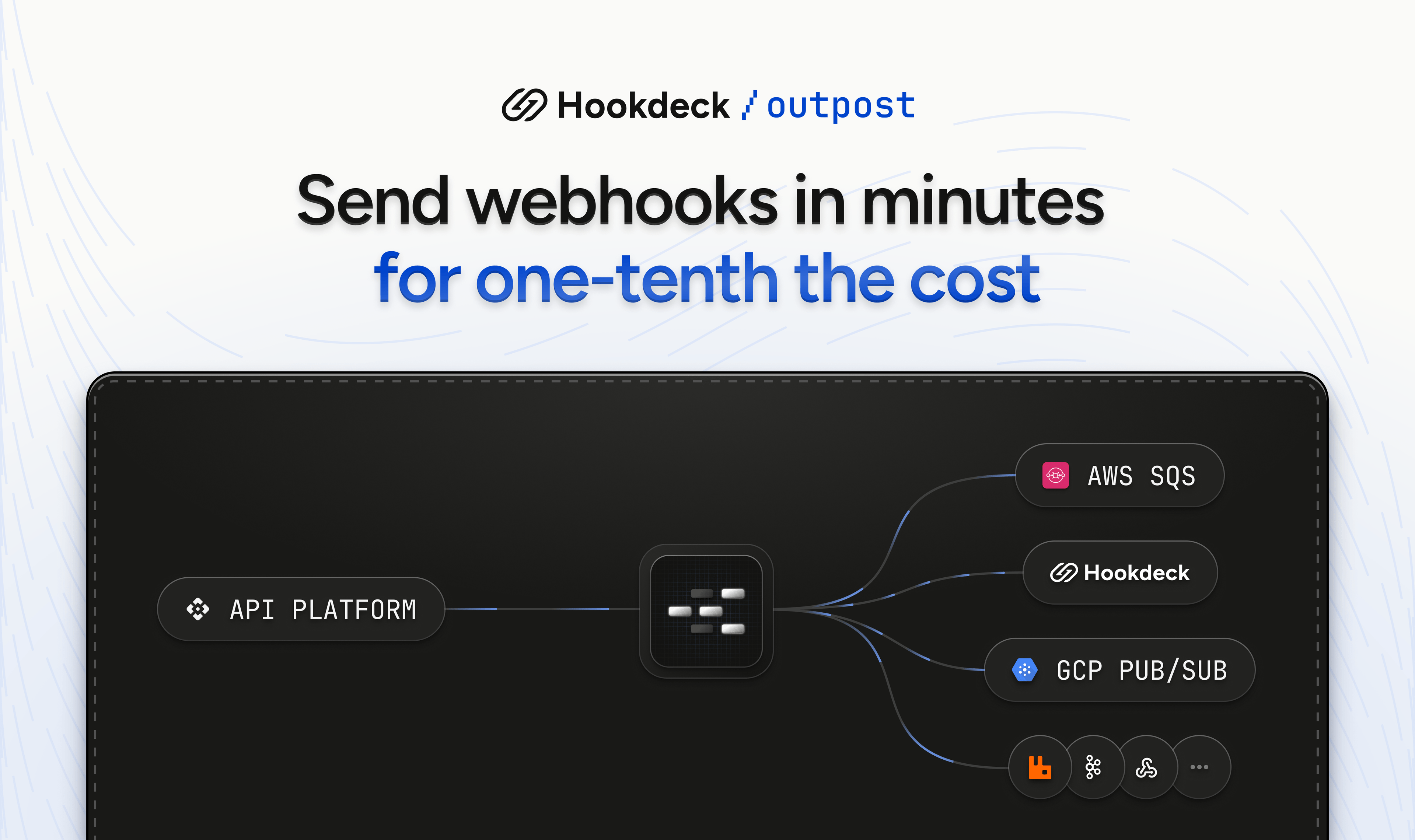
Before looking at individual features, it's worth understanding the product philosophy behind Outpost. It's intentionally focused: providing the essentials for reliable, multi-destination event delivery with an exceptional developer experience, without the bells and whistles that drive up cost.
This means Outpost doesn't try to match Svix feature-for-feature on things like transformations, connectors, FIFO ordering, or monetization gating. Instead, it focuses on doing the core job well (delivering events reliably to wherever your customers want them) but at a fraction of the cost.
We think the features others charge a premium for are either unnecessary for most teams, or better handled in application code. Outpost's bet is that most teams would rather pay 10x less per event, get native multi-destination support and full open-source parity, than pay for Enterprise features they'll never use.
Pricing and rate limits
This is where Outpost's focused approach pays off most directly.
Hookdeck Outpost pricing is $10 per million events on a pay-as-you-go basis with no per-second rate cap at any tier. The self-hosted version is free with no usage limits. The managed Starter tier includes 50,000 events and is pure pay-as-you-go with no monthly minimum; the Growth tier at $499/mo adds SLAs and SSO.
Svix Dispatch includes 50,000 messages a month on its Free, Basic, and Professional plans. Free has no overage option; Basic (from $20/mo) and Professional (from $490/mo) charge $100 per million messages beyond the included 50,000. Rate limits are capped: 50 messages/sec on Free, 200/sec on Basic, 800/sec on Professional, and custom on Enterprise.
At scale, the cost difference is stark. At 10 million events per month, Outpost costs $100. On Svix Basic, you'd pay the $20/mo base plus overage, roughly $1,015/mo; on Professional, roughly $1,485/mo. That's 10-15x more expensive. Outpost's uncapped rate limits also mean you won't hit throughput ceilings during traffic spikes, while Svix's 800/sec Professional cap could become a bottleneck for high-volume senders.
Destination types
This is Outpost's most significant functional differentiator.
Hookdeck Outpost natively supports delivering events to webhooks (HTTP endpoints), AWS SQS, S3, GCP Pub/Sub, RabbitMQ, ServiceBus, EventBridge, Kinesis, Kafka, Cloudflare Queues, and Hookdeck Event Gateway, 11 event destinations in total. All destination types are available on every tier, including the self-hosted version, with no add-ons or additional components.
Svix Dispatch delivers natively to HTTP webhook endpoints. For non-webhook destinations, Svix offers Amazon SQS, GCP Pub/Sub, RabbitMQ, and Redis via the Bridge daemon, a separate add-on component you need to deploy and manage. Object storage endpoints (AWS S3, Azure ABS, Google GCS) are available on Enterprise only. Svix does not support Kafka or EventBridge.
The practical impact is significant. If your customers want events delivered to their SQS queues, service buses, Pub/Sub subscriptions, Kafka topics, or EventBridge event buses, Outpost handles that natively, with the same API, portal, and configuration. With Svix, you need the Bridge daemon running alongside Dispatch, which adds operational complexity. And if a customer needs Kafka or EventBridge, Svix can't deliver there at all.
Deployment and open source
Hookdeck Outpost is available as both a hosted SaaS and a fully self-hosted deployment under Apache 2.0. The self-hosted version has full feature parity with the managed service — same codebase, same capabilities, no proprietary "premium" fork. It deploys as a single binary or Docker container with horizontal scaling support, and is designed as a backward-compatible drop-in alongside existing webhook implementations.
Svix Dispatch is available as a hosted SaaS and a self-hosted open-source emulator. The self-hosted emulator has a reduced feature set compared to the managed service. It's useful for development and testing but is not intended as a production-equivalent self-hosted deployment.
If self-hosting matters to your team (for data sovereignty, compliance, or cost reasons) the difference in open-source parity is meaningful. Outpost's self-hosted version is the full product, not a subset.
Customer portal
Both products offer a user portal that let your customers manage their webhook subscriptions, but the customization depth differs.
Hookdeck Outpost provides a white-label React SPA with full theming: light/dark mode, custom logo, accent color, and complete branding removal. Beyond the embeddable portal, Outpost also offers a full API with JWT/API key authentication for building entirely custom portal UIs. So if the embeddable component doesn't fit your product's design system, you can build your own.
Svix Dispatch offers an embeddable portal UI available on all tiers, with white-label support (logo, font, color, custom headers, and channel naming) on Professional plans and above. Svix does not offer documented support for building custom portal UIs via their API.
If an embeddable portal with basic branding is sufficient, both products work. If you need deep theming control or want to build a fully custom UI that integrates with your product's design, Outpost's custom UI API provides that flexibility.
Observability
Hookdeck Outpost includes OpenTelemetry support (traces, metrics, and logs) on all tiers, including the self-hosted version. You get delivery lifecycle visibility from day one without needing an Enterprise contract.
Svix Dispatch offers OpenTelemetry streaming on Enterprise only. Lower tiers provide endpoint failure notifications but not the structured telemetry data that integrates with observability platforms like Datadog, Grafana, or Honeycomb.
If your team already uses OpenTelemetry or any OTel-compatible observability platform, Outpost integrates out of the box on every tier. With Svix, that capability is behind the Enterprise paywall.
Retries and reliability
Hookdeck Outpost provides automatic retries with exponential backoff and manual retry via the API and portal. Circuit breaking automatically detects unhealthy endpoints and stops sending to them, resuming delivery once the endpoint recovers. Destinations are auto-disabled after consecutive failures to prevent wasted delivery attempts. Retry customization is robust, and users can set custom retry schedules.
Svix Dispatch offers automatic retries with both standard and custom exponential backoff configurations, plus manual retry. Circuit breaking is also supported, and Svix provides endpoint failure notifications.
Both products handle the core retry and circuit-breaking functionality well. Svix's custom backoff configuration gives more granular control over retry timing. Outpost's auto-disable behavior provides a clear operational signal when an endpoint is persistently failing.
Security
Hookdeck Outpost provides webhook signatures with signature rotation support, idempotency headers, and timestamps for replay protection.
Svix Dispatch provides both symmetric and asymmetric (ed25519) webhook signatures.
Svix has the edge here with asymmetric signature support (ed25519), which allows recipients to verify signatures without sharing a secret key — useful for security-sensitive customers. Outpost covers the standard signing, rotation, and idempotency requirements that most webhook implementations need.
Event topics and filtering
Hookdeck Outpost supports topic-based subscriptions with content-based filtering, allowing your customers to subscribe to specific event types and filter based on event content.
Svix Dispatch offers event types with filtering, plus destination filters configurable via the portal.
Both products let customers subscribe to the event types they care about and filter on content. The implementations are comparable for most use cases.
Multi-tenancy
Hookdeck Outpost provides native tenant isolation, keeping each of your customers' webhook configurations, delivery history, and endpoints separated.
Svix Dispatch uses a native application/endpoint model that similarly isolates customer data.
Both products are designed for multi-tenant SaaS use cases. The approaches differ in naming and structure, but the outcome (clean tenant isolation) is the same.
What Svix Dispatch offers that Outpost doesn't
Svix Dispatch has a broader feature surface, particularly on Professional and Enterprise tiers. Here's what Outpost intentionally doesn't include:
Transformations: Svix offers JavaScript transformations via the portal on all plans, letting your customers modify payloads before delivery. With Outpost, payload transformation happens in your application code before you send the event.
Connectors: Svix provides pre-made integrations to connect webhooks to 15+ services via the portal (1 on Free and Basic, 3 on Professional, unlimited on Enterprise). Outpost doesn't have equivalent connector functionality.
FIFO ordering: Svix offers guaranteed first-in-first-out delivery ordering on Enterprise. Outpost does not support ordered delivery. For most webhook use cases, at-least-once delivery with idempotency handling is sufficient and Outpost supports idempotency headers out of the box. True FIFO delivery requires serialized delivery of events which severally limits throughput and is not practical for most use cases.
Polling support: Svix provides a stream of events via polling on Enterprise, for customers who can't expose HTTP endpoints. Outpost doesn't support polling, but its native support for SQS, Pub/Sub, Kafka, and other non-HTTP destinations addresses the same underlying problem (delivering events to customers who don't want to run a webhook endpoint) through a different (and more resilient) approach.
Gating and monetization: Svix Enterprise lets you gate features like mTLS, OAuth, endpoint creation, and transformations as paid add-ons for your customers. Outpost doesn't have equivalent monetization features.
Throttling: Svix allows user-configurable throttling via the portal. Outpost doesn't expose throttling controls to end users. However Outpost can be used in conjunction with Hookdeck Event Gateway delivery rate limiting to achieve similar results.
Authentication types: Svix supports mTLS and OAuth on Enterprise. Outpost uses JWT and API key authentication.
Terraform provider: Svix has a Terraform provider for infrastructure-as-code. Outpost offers full API support but no dedicated Terraform provider yet (it's planned for Q2-Q3 2026).
Use your own IPs: Svix Enterprise allows customers to use their own static IPs for outbound delivery. Outpost provides static IPs and user-managed forward proxies which can be used to control the delivery IP address. Outpost doesn't let you bring your own IPs directly.
Each of these features adds value for specific use cases. The question is whether they're worth the price difference for your product. At $100/million messages vs $10/million, and $490/mo minimum vs pay-as-you-go, the cost of those additional features is significant.
Compliance and data residency
Svix holds SOC 2 Type II, HIPAA, PCI-DSS, GDPR, CCPA, and PIPEDA certifications, and offers hosting in custom regions. The custom-region option is an advantage for teams with strict data residency requirements.
Hookdeck holds SOC 2 Type II, HIPAA, GDPR, CCPA, and PIPEDA certifications, and signs Business Associate Agreements (BAAs). Outpost is currently hosted in the US, EU and Asia (Singapore). Self-hosted and managed on-prem deployments are also available for compliance requirements.
Both platforms share SOC 2 Type II, HIPAA, GDPR, CCPA, and PIPEDA certifications. If your organization has a hard requirement for PCI-DSS or needs custom-region data residency, Svix meets those out of the box today and Hookdeck does not.
Uptime SLAs
Hookdeck Outpost offers tiered uptime SLAs: 99.99% on Growth and 99.999% on Enterprise.
Svix Dispatch offers tiered SLAs: 99.9% on Basic, 99.99% on Professional, and 99.999% on Enterprise. The Free plan has no uptime SLA.
Both platforms offer comparable SLAs at similar tiers, with 99.999% uptime available on each platform's Enterprise plan.
When to choose Hookdeck Outpost
Outpost is the stronger choice when your customers need events delivered to destinations beyond HTTP webhooks (SQS, Pub/Sub, ServiceBus, RabbitMQ, S3, EventBridge, Kinesis, Kafka, Cloudflare Queues), when cost efficiency at scale matters ($10/million vs $100/million), when you need OpenTelemetry observability without an Enterprise contract, when you want full open-source parity for self-hosted deployment, when you need to build a custom portal UI, or when uncapped rate limits are important for your traffic patterns.
When to choose Svix Dispatch
Svix Dispatch may be the right choice if you need transformations, connectors, or FIFO ordering out of the box, or if you have a hard compliance requirement for PCI-DSS certification, or need custom-region data residency. It's also a good choice if monetization gating (making features paid add-ons for your customers) is a product requirement, if mTLS or OAuth authentication is required, if you need polling support for customers who can't expose endpoints and non-HTTP destinations don't address their needs, or if the broader SDK coverage (7+ languages) is important for your integration story.
Conclusion
Hookdeck Outpost and Svix Dispatch both solve the problem of sending webhooks reliably. The difference is in what you're paying for. Outpost delivers the essentials (native multi-destination support, OpenTelemetry on every tier, a white-label portal with custom UI API, full open-source parity, and uncapped rate limits) at up to 10x lower cost per event. Svix Dispatch offers a broader feature set with transformations, connectors, FIFO ordering, and monetization gating, but gates many of those features to Professional ($490/mo) or Enterprise.
For teams that need reliable event delivery to diverse destinations without paying for features they won't use, Outpost is the more cost-effective choice. For teams that need the full suite of portal add-ons, ordering guarantees, or monetization capabilities, Svix Dispatch offers those at a premium.
Resources
