 Gareth Wilson
Stop losing webhooks in n8n: the Hookdeck node is here
n8n's Webhook trigger works well right up until you hit scale. Restart your instance mid-deploy and providers get 404s. A flaky provider double-fires and you send the same email twice. A workflow fails on a payment event, and the event is gone. Hoodeck Event Gateway helps you with all of that, so today we're releasing @hookdeck/n8n-nodes-hookdeck, an open source community node package that puts Event Gateway between your webhook providers and your n8n workflows. It addresses all the common complaints of working with webhooks right from inside the n8n canvas.
Two nodes
Hookdeck Event Gateway Trigger replaces the plain Webhook trigger. When you activate your workflow, the node provisions a Hookdeck connection pointing at that workflow and hands you a public source URL to give your provider. Every event now flows through Event Gateway first: verified, queued durably, deduplicated, rate-limited, and retried on failure. All of it is configured as node options rather than dashboard settings.
Hookdeck Event Gateway is the action node. It works with events, delivery attempts, requests, issues, sources, destinations, and connections, so you can retry a failed event or pull up the original request a provider sent.
See it in action
You can combine n8n's AI agent with the Hookdeck n8n nodes to create smart workflows. In this example, Phil walks through a scenario with a webhook delivery failing. An agent picks it up, counts how many events were failing, and determines it's not a transient issue. So it pauses the connection, stops the retries, and writes up an incident note and triggers an on-call notification.
What the Hookdeck nodes fix
Deploys and downtime stop losing events
Deactivate a workflow that uses the Hookdeck Event Gateway Trigger and the connection is paused rather than deleted. Events keep arriving at Hookdeck, where they are held until the workflow comes back. Reactivate it, and everything that arrived during the gap is delivered. A deploy or a maintenance window no longer costs you events, and your provider webhooks don't care that your instance was down for a few minutes.
If a delivery fails because n8n was unreachable or a run errored, Event Gateway retries it: up to 50 attempts, with exponential or linear backoff. The default (five exponential retries, applied even if you never open the options panel) covers the common cases out of the box.
Duplicate events cost one execution, not two
The trigger applies a deduplication window at ingest: 60 seconds by default, configurable up to one hour. A double-firing provider produces one workflow execution. For stricter guarantees, every delivery carries hookdeck.idempotencyKey, stable across retries of the same event, so you can key your own checks on it without building your own plumbing.
Failed runs can be retried and replayed
The trigger has two acknowledgement modes. Sync holds the HTTP response until your workflow finishes: a failed run answers 5xx, and Hookdeck's retry rules apply to the run itself. No error workflow and no digging through execution history.
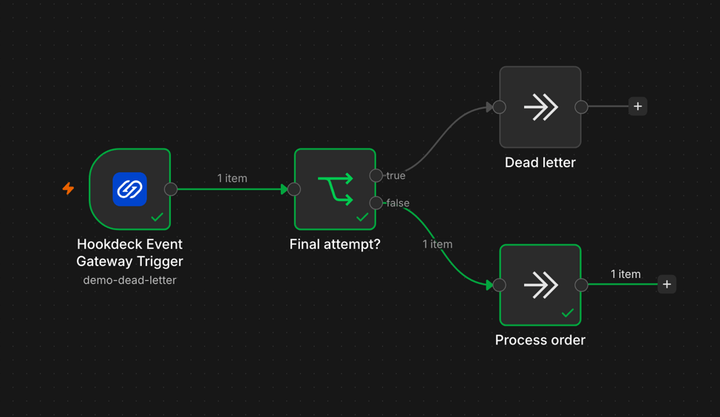
Async Retry (the default) acknowledges immediately, which suits longer workflows. Recovery there is a workflow step: add the Hookdeck node with Event > Retry to your error workflow, pass {{ $json.hookdeck.eventId }}, and the event is redelivered. Every delivery also includes hookdeck.isLastAttempt, so wiring up a dead-letter branch is one IF node.
And because Event Gateway stores events and the original requests behind them, you can fix up a workflow and retry the event.
Bursts don't take down your instance
Delivery rate limits cap how fast Event Gateway delivers into n8n: per second, per minute, per hour, or as a cap on concurrent executions. Group keys go further: rate-limit by a payload path, such as a customer ID, so one busy tenant can't crowd out everyone else. It's the webhook rate limiting the community has requested since 2023, enforced upstream of n8n where it can protect the instance.
Signature verification without Code nodes
Pick your provider from 160+ source types (Stripe, Shopify, GitHub, Twilio, and the rest) and the platform's verification scheme is applied at Hookdeck's edge. Forged or tampered payloads never reach n8n. Generic sources support HMAC, API key, and basic auth verification, with a JSON escape hatch for anything unusual.
Deliveries from Event Gateway into n8n are themselves signed, and the trigger verifies them against the raw body by default; unsigned requests get a 401 and never start a workflow.
Get started
The node is verified by n8n, so it installs from inside the editor on both n8n Cloud and self-hosted:
- Open the nodes panel (click + or press N) and search for Hookdeck.
- Select Hookdeck Event Gateway under "More from the community" and click Install. You'll need to be an instance owner or admin; once installed, everyone on the instance can use it.
- Create a Hookdeck Event Gateway API credential with your project's API key, and drop the Hookdeck Event Gateway Trigger into a workflow.
Self-hosting with verified nodes disabled? Install it by package name from Settings → Community nodes: @hookdeck/n8n-nodes-hookdeck.
The README covers the full option set, acknowledgement modes, and more.
If you hit problems or want capabilities the node doesn't have yet, open an issue, or tell us in the Hookdeck community Slack.