 Gareth Wilson
Hookdeck Outpost Alternatives for Sending Webhooks
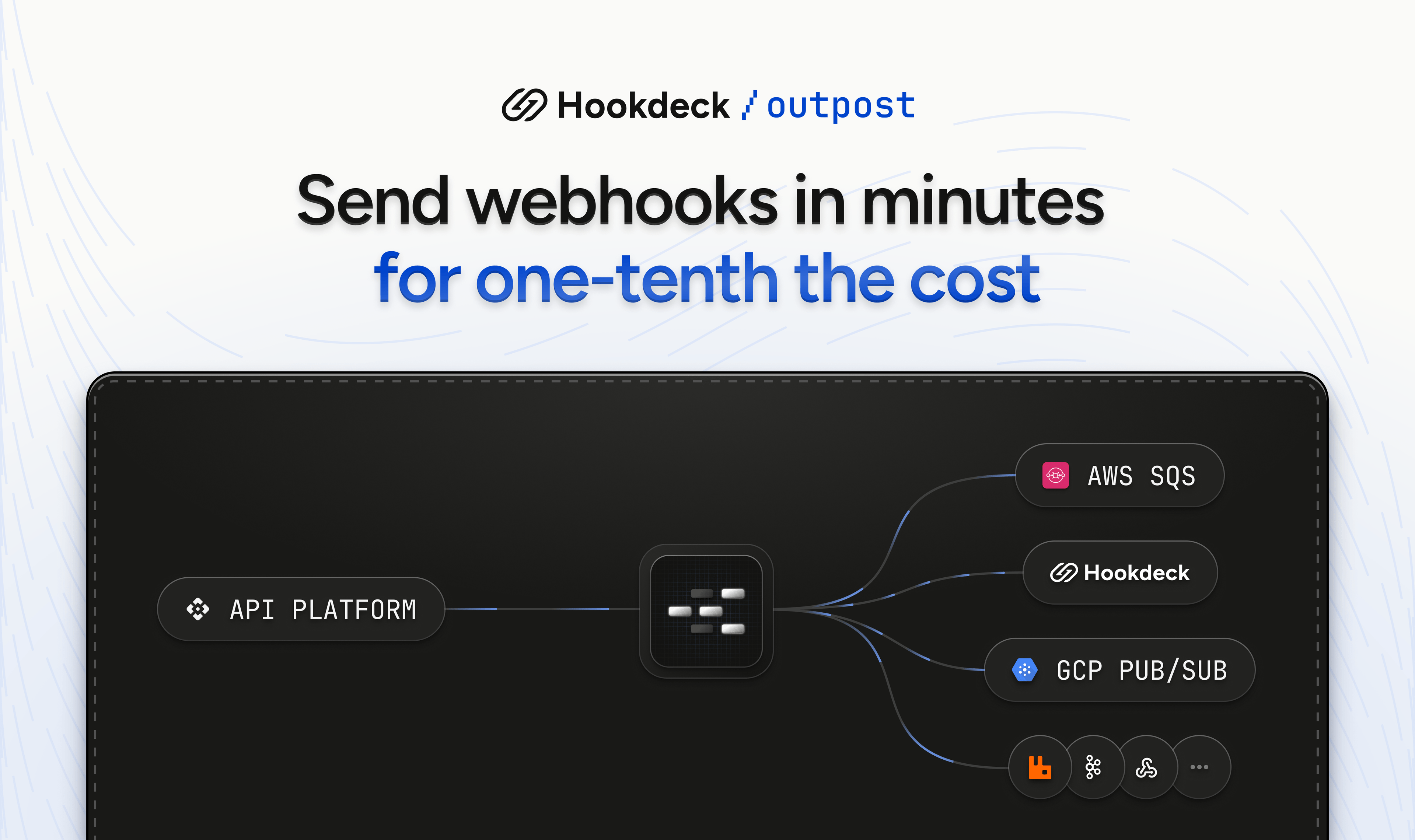
If you're evaluating webhook sending infrastructure, you've probably come across Hookdeck Outpost. Outpost is a serverless service for sending webhooks and events to your customers, with native multi-destination delivery (SQS, Pub/Sub, S3, ServiceBus, RabbitMQ, EventBridge, Kafka, and more), OpenTelemetry observability on every tier, a white-label customer portal with custom UI API, and pay-as-you-go pricing at $10/million events.
But no product is the right fit for every team. In this article, we'll look at the most common alternatives to Outpost: what they do well, what users say about them (from G2 reviews), and why teams choose Outpost over the alternatives.
Svix Dispatch
Read the Hookdeck Outpost vs Svix Dispatch in-depth comparison.
Svix Dispatch is the most established webhook sending platform. It's the outbound delivery component of the Svix platform, which also includes Svix Ingest (receiving) and Svix Stream (real-time streaming).
| Hookdeck Outpost | Svix Dispatch | |
|---|---|---|
| Founded | 2020 | 2021 |
| Open source | Apache 2.0 (Go) | MIT (Rust) |
| Pricing from | Pay-as-you-go ($10/million events) | $490/mo (Professional) |
| Per-event cost | $10/million | $100/million |
| Destination types | Webhooks, SQS, S3, Pub/Sub, ServiceBus, RabbitMQ, EventBridge, Kafka, Hookdeck Event Gateway — all native | Webhooks native; SQS, Pub/Sub, RabbitMQ, Redis via Bridge add-on; object storage on Enterprise |
| Rate limits | Uncapped | 50/s (Free), 400/s (Professional) |
| Observability | OpenTelemetry on all tiers | OpenTelemetry on Enterprise only |
| Customer portal | White-label + custom UI API | White-label on Professional+; no custom UI API |
| Self-hosted parity | Full feature parity | Emulator with reduced features |
| Uptime SLA | 99.99% (Growth), 99.999% (Enterprise) | 99.9% to 99.999% (tier-dependent) |
Key differences
Destination flexibility. This is the most fundamental difference. Outpost delivers events natively to nine destination types — SQS, S3, Pub/Sub, ServiceBus, RabbitMQ, EventBridge, Kafka, and Hookdeck Event Gateway — without add-on components. Svix delivers to HTTP natively and requires the Bridge daemon (a separate component you deploy and manage) for SQS, Pub/Sub, RabbitMQ, and Redis.
Pricing. Outpost charges $10/million events on a pay-as-you-go basis with no monthly minimum and no rate cap. Svix Professional starts at $490/mo with $100/million messages after 50K included, and caps throughput at 400 events/sec. At 10 million events/month, Outpost costs $100; Svix costs roughly $1,485. That's nearly 15x more.
Self-hosted parity. Outpost's self-hosted version (Apache 2.0) is the same codebase as the managed service: full feature parity, no proprietary fork. Svix's self-hosted offering is an emulator with a reduced feature set, intended for development and testing rather than production deployment.
Observability. Outpost includes OpenTelemetry (traces, metrics, logs) on every tier, including the self-hosted version. Svix gates OpenTelemetry to Enterprise. Lower tiers get endpoint failure notifications only.
Feature surface. Svix offers a broader set of capabilities: JavaScript transformations, 15+ pre-built connectors, FIFO ordering, polling, throttling, and monetization gating. Many of these are gated to Professional ($490/mo) or Enterprise. Outpost intentionally doesn't include these, the bet is that most teams would rather pay 10x less per event and handle transformations in application code than pay for Enterprise features they won't use.
What people like about Svix
Users highlight:
“It has taken care of delivering Webhook events”
“The integration was smooth and saved us a lot of code”
“Svix made our lives a lot easier by allowing us to manage our webhooks in one spot.”
Reviewers praise Svix's reliability, developer-friendly APIs and SDKs, and responsive customer support.
What people dislike about Svix
The most common criticisms align with areas where Outpost differentiates:
“Paid plan is quite expensive for early stage startup.”
“Could use some more telemetry features to allow it to be more of a built in observability platform.”
“The default UI isn't the prettiest”
“UI...could improve on the performance side.”
The pricing concern is notable. Svix Professional starts at $490/mo, with per-event costs at $100/million — 10x higher than Outpost. The observability and portal customization feedback also points to areas where Outpost has invested more deeply.
Convoy
Read the Hookdeck Outpost vs Convoy in-depth comparison.
Convoy is a unified webhook gateway that handles both sending and receiving in a single product. It's open source under MIT license and built on a PostgreSQL-backed architecture, which makes it a fit for teams already running PostgreSQL who want self-hosted flexibility.
| Hookdeck Outpost | Convoy | |
|---|---|---|
| Open source | Apache 2.0 (Go) | MIT (Go) |
| Pricing from | Pay-as-you-go ($10/million events) | $99/mo (Pro) |
| Destination types | Webhooks, SQS, S3, Pub/Sub, ServiceBus, RabbitMQ, EventBridge, Kafka, Hookdeck Event Gateway — all native | Webhooks only |
| Observability | OpenTelemetry on all tiers | Prometheus metrics only |
| Customer portal | White-label + custom UI API | Embeddable, no customization |
| Data retention | 7 days (Starter), 30 days (Growth) | 7 days (Pro) |
| Rate limits | Uncapped | 25/s (Pro) |
| Uptime SLA | 99.99% (Growth), 99.999% (Enterprise) | 99.99% (Pro), 99.999% (Enterprise) |
| SSO | Growth ($499/mo) | Pro ($99/mo) |
Key differences
Destination types. Outpost delivers events natively to nine destination types beyond HTTP. Convoy delivers to webhook endpoints only. If your customers want events in their SQS queues or Pub/Sub subscriptions, Convoy can't deliver there at all.
Observability. Outpost includes a metrics dashboard and supports OpenTelemetry (traces, metrics, logs) on every tier. Convoy provides Prometheus metrics for queue and ingestion health, but no per-event traces, no per-delivery logs, and no integration with Datadog, Grafana, or Honeycomb.
Data retention. Outpost retains delivery data for 7 days (Starter) or 30 days (Growth). Convoy retains 7 days on Pro. Outpost Starter matches Convoy Pro, and Growth extends retention to 4x longer, which matters when a customer claims they didn't receive an event and you need to investigate.
Portal customization. Outpost provides a white-label React SPA with full theming plus a custom UI API for building your own portal. Convoy's portal is embeddable but offers no customization — it will look like Convoy's portal inside your product.
SSO pricing. Convoy includes SSO at $99/mo (Pro). Outpost requires the $499/mo Growth plan. If SSO is a hard requirement at a lower budget, this is a genuine Convoy advantage.
Self-hosted architecture. Both are open source. Convoy's PostgreSQL-backed architecture fits naturally if you're already running PostgreSQL. Outpost deploys as a single binary with less operational overhead.
Hookdeck Outpost vs Hook0
Read the Hookdeck Outpost vs Hook0 in-depth comparison.
Hook0 is a lightweight webhooks-as-a-service platform built in Rust. It's the simplest of the three alternatives here — focused on getting webhook delivery up and running quickly, with an on-premise deployment option for teams with strict data sovereignty requirements.
| Hookdeck Outpost | Hook0 | |
|---|---|---|
| Open source | Apache 2.0 (Go) | SSPL v1 (Rust) |
| Pricing from | Pay-as-you-go ($10/million events) | €59/mo (Startup — up to 30K events/day) |
| Per-event cost | $10/million | ~€65/million (Startup tier) |
| Destination types | Webhooks, SQS, S3, Pub/Sub, ServiceBus, RabbitMQ, EventBridge, Kafka, Hookdeck Event Gateway — all native | Webhooks only |
| Observability | OpenTelemetry on all tiers | Dashboard and metrics API; no OpenTelemetry |
| Customer portal | White-label + custom UI API | Custom subdomain and logo only |
| Uptime SLA | 99.99% (Growth), 99.999% (Enterprise) | 99.9% |
| Compliance | SOC 2 Type II, HIPAA, GDPR, CCPA, PIPEDA | GDPR; relies on Clever Cloud's SOC 2 |
| Data residency | US, EU, Asia | EU only |
Key differences
Destination types. Outpost delivers events natively to nine destination types. Hook0 delivers to HTTPS endpoints only. If a customer wants events in SQS, Kafka, or Pub/Sub, you'd need to build a relay layer with Hook0.
Cost at scale. Hook0 prices by daily event caps: €59/mo for 30K/day (~900K/month), €190/mo for 100K/day (~3M/month). At 3 million events/month, Outpost costs $30; Hook0 Pro costs €190 (~$205). That's roughly 7x more expensive. Hook0's daily caps also mean you pay for peak capacity whether you use it consistently or not.
Observability. Outpost includes a metrics dashboard and supports OpenTelemetry (traces, metrics, logs) on every tier. Hook0 provides event/response persistence, a dashboard, and a metrics API — but no structured telemetry via OpenTelemetry. Delivery data stays within Hook0's tooling rather than flowing into your existing observability stack.
On-premise deployment. Hook0 offers a dedicated on-premise tier for organizations that need infrastructure deployed entirely within their own data center. Outpost offers hosted SaaS and self-hosted deployment but not dedicated on-premise infrastructure as a managed option. If on-premise is a hard requirement, this is Hook0's clearest advantage.
Uptime SLA. Outpost guarantees 99.99% on Growth and 99.999% on Enterprise. Hook0 offers 99.9%.
Compliance. Hookdeck holds SOC 2 Type II, HIPAA, GDPR, CCPA, and PIPEDA compliance directly. Hook0 relies on Clever Cloud's SOC 2 / ISO 27001 certifications. For enterprise procurement processes that require vendor-level SOC 2, this creates friction with Hook0.
Why teams choose Hookdeck Outpost
Teams switch to Outpost for different reasons, but a few themes come up consistently: cost, destination flexibility, and the speed of getting to production.
Cost-effective pricing, even at scale
Francisco Delgado, Founder at Ordinal, switched from Svix to Outpost in just a couple of days:
“With fair pricing, top notch support and a beautiful user-facing UI, Outpost was a no brainer choice to send webhooks to our users.”
The cost difference was immediate. Ordinal's monthly bill went from ~$600 on Svix to $10 on Outpost.
Shipping faster with multi-destination support
Ryan Burke, Head of Product at Deck, chose Outpost for the speed it gave his team:
“Outpost made it easy and quick to ship new event destinations, event topics, and level up our delivery infrastructure for customers.”
For teams adding webhook delivery to their product, the time from "we need webhooks" to "our customers are receiving events" is a meaningful competitive advantage.
Simplifying outbound delivery infrastructure
Ben Ng, CTO & Co-Founder at CFX Labs, found that Outpost consolidated their delivery complexity:
“Outpost has let us centralize and simplify our outbound webhook delivery, multiply the number of ways we can deliver events, and stop worrying about webhook plumbing.”
Going beyond webhooks
Lauren Long, Co-Founder & CTO at Ampersand, needed to deliver events to customers who don't want to run HTTP endpoints:
“Outpost has enabled us to go beyond webhooks when sending events to our customers. This allows them to handle high volume data from us in a scalable and flexible manner.”
This is the use case Outpost's native multi-destination support was built for — giving your customers the choice of receiving events via SQS, Pub/Sub, or any supported destination, not just HTTP.
Conclusion
Every webhook sending platform makes trade-offs. Svix Dispatch offers the broadest feature surface with transformations, connectors, and monetization gating — but at $490/mo minimum and $100/million events, many teams find themselves paying for capabilities they don't use. Convoy provides a self-hosted unified gateway at a lower price point, but delivers to HTTP only and lacks the observability depth teams need in production. Hook0 offers simplicity and on-premise deployment, but with HTTPS-only delivery and a 99.9% SLA.
Outpost focuses on doing the core job well: delivering events reliably to wherever your customers want them — nine destination types natively, OpenTelemetry on every tier, a white-label portal with custom UI API, full open-source parity, and low, transparent pricing at $10/million events.
Try Hookdeck Outpost for free
Send webhooks reliably to any destination — at a fraction of the cost.
