 Gareth Wilson
Outpost Early-access, Webhook Skills & Metrics API - Hookdeck January 2026
January saw Hookdeck Outpost released in early-access, along with new webhook-skills for AI agents, and the addition of the Metrics API. Let's take a closer look at what's new in Hookdeck.
Hookdeck Outpost: Early Access
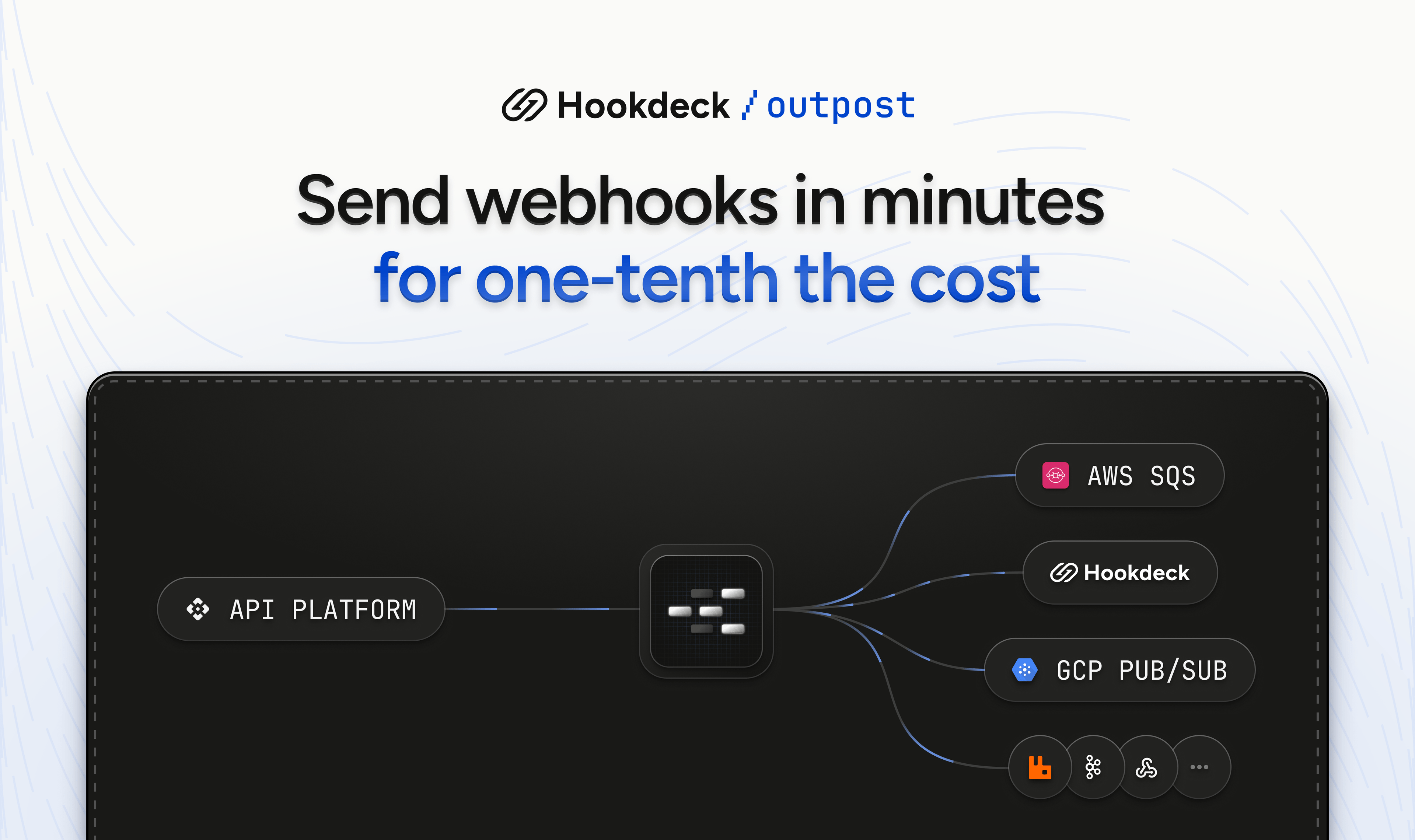
The biggest news this month is the launch of Hookdeck Outpost in Early Access. Outpost is a fully managed, serverless solution for sending webhooks. Built on the same open-source Apache 2.0 codebase that powers self-hosted deployments, Outpost delivers enterprise-grade webhook delivery at a fraction of the cost of existing solutions.
The platform focuses on essential webhook delivery features without unnecessary complexity: at-least-once delivery guarantees, topic-based subscriptions, configurable retry strategies, and multi-tenant support. What sets Outpost apart is its support for Event Destinations, allowing delivery not just to webhook endpoints but directly to customers' queues, brokers, and event gateways including AWS SQS, RabbitMQ, GCP Pub/Sub, and Amazon EventBridge.
Outpost addresses the core challenge many developers face: building reliable webhook infrastructure is complex, but buying existing solutions is prohibitively expensive. Starting at $10 per million events, Outpost provides up to 10x cost savings compared to other cloud-based webhook services while maintaining the reliability guarantees developers need.
The managed service includes serverless scaling, SOC2 compliance, and comprehensive monitoring through a customer-facing portal that lets end users manage their own webhook destinations and debug delivery issues.
Request Early Access to Hookdeck Outpost or explore the open-source project on GitHub.
Webhook Skills: AI Agents for Webhook Management
We launched webhook-skills, an open-source project that gives AI coding agents framework-optimized, vendor-specific knowledge to scaffold, debug, and iterate on webhook integrations.
When you're integrating webhooks from a new API platform or SaaS and ask your AI coding agent to set up the webhook, the code it generates often looks reasonable but it can get tripped up by things like signature verification, or raw body handling.
So we built webhook-skills to give AI coding agents the knowledge to implement webhook integrations correctly the first time.
For now the following providers and frameworks are supported:
- Providers: Stripe, Shopify, GitHub, OpenAI, Resend, Paddle, ElevenLabs, Chargebee, and more.
- Frameworks: Next.js, Express, and FastAPI.
There's also a webhook-handler-patterns skill for best practices implementing webhook idempotency, error handling, retry logic, and async processing. As well as a hookdeck-event-gateway skill for setting up routing, replay, and monitoring with Hookdeck.
To get started, check out the repo and install skills using npx skills.
New Metrics API
The new Metrics API gives you the same reporting data as the Hookdeck dashboard, but available via HTTP. You can query it directly to build internal dashboards, generate reports, or feed your own alerting systems.
Endpoints include:
- /requests - Request volume, acceptance rates, rejections by Source
- /events - Event counts, success/failure rates by Connection
- /attempts - Delivery attempts, latency, failure rates by Destination
- /events-by-issue - Events grouped by issue for troubleshooting
- /queue-depth - Current pending events per Destination
- /transformations - Transformation execution metrics
All endpoints return time-bucketed data with dimensions and aggregated values. Stateful metrics like queue depth are sampled every 5 seconds, while everything else updates in near real-time.
Hookdeck already included Metrics export (to Datadog, Prometheus, or New Relic). While that's useful for showing Hookdeck metrics alongside your other infrastructure data, if you're wanting to build something custom (like an internal status page, Slack bot, or weekly report) then the Metrics API is the way to go.
Outpost v0.12.0 & v0.11.0
Version 0.12.0 introduced breaking changes that improve the API structure by adding /tenants prefixes to tenant-scoped routes and implementing RediSearch for more efficient tenant listing. While these changes require migration, they establish a cleaner foundation for multi-tenant webhook management. Version 0.11.0 focused on compatibility and developer experience improvements.
Review the v0.12.0 Migration Guide before upgrading existing deployments.
CLI v1.6.0 & v1.5.0
The Hookdeck CLI received two important updates this month that expand integration capabilities and improve local development workflows. Version 1.6.0 adds support for GCP destination authentication, enabling seamless webhook delivery to Google Cloud Platform services. Version 1.5.0 introduced TCP-based health checks for the listen command, providing more reliable local server monitoring during development. These improvements make the CLI more reliable for both local testing and production integrations across different cloud platforms.
Install the latest CLI version to access GCP authentication and improved health monitoring.
New Source types
We also added new source types for Hookdeck Event Gateway, including Cursor and USPS, both implementing HMAC signature verification for secure webhook processing.