 Gareth Wilson
Hookdeck Event Gateway vs Convoy: Webhook Receiving Compared
Managing a few webhooks is simple. But as you add more, you need to start thinking about queuing, routing, and retry mechanisms to give you the certainty you need to rely on them. Hookdeck's Event Gateway ensures you can ingest and act on inbound webhooks without setting up custom infrastructure.
If you're evaluating infrastructure for receiving inbound webhooks, Hookdeck's Event Gateway and Convoy are two products worth comparing. Both handle incoming webhooks, but they approach the problem differently: Event Gateway is a purpose-built inbound webhook platform with deep queueing, filtering, and observability, while Convoy is a unified webhook gateway that bundles sending and receiving into a single product, with incoming webhooks as a secondary capability.
This comparison breaks down the meaningful differences across every major capability area so you can make an informed decision.
At a glance
Both products can receive webhooks and forward them to your services. The difference is in depth. The table below shows where each product sits across the key capability areas.
| Capability | Hookdeck Event Gateway | Convoy |
|---|---|---|
| Pre-configured sources | 160+ | 3 |
| Queueing | Durable queue with backpressure | No dedicated queue (PostgreSQL) |
| Filtering | Advanced field-level rules on payload, headers, paths | Event-type and payload filters |
| Deduplication | Exact and field-based | Exact only |
| Routing | Dynamic rules, fan-out, conditional logic | Basic endpoint routing |
| Transformations | Code and visual editor | Code |
| Observability | Visual traces, full-text search, bulk ops, latency percentiles | Basic dashboard, events received |
| Issue tracking | Custom triggers, status tracking, team workflows | - |
| Alerting | Email, Slack, Teams, PagerDuty, OpsGenie, Webhooks | Email, Webhooks |
| Content types | Text, JSON, XML, form-encoded, JWT, form-data, binary | JSON, form-encoded |
| Retries | Linear or exponential backoff, bulk retry | Linear or exponential backoff |
| Logging | Full-text search, header/path/JSON filters | Date, owner, event type, source filters |
| Rate limiting | Configurable with backpressure absorption | Configurable |
| Per-tenant delivery rates | Delivery Groups: keyed per-tenant queues, fair scheduling, overrides | - |
| Developer tools | Console (60+ sample providers), CLI | CLI |
| Uptime SLA | 99.999% | 99.99% (Pro), 99.999% (Enterprise) |
| Compliance | SOC 2 Type II, HIPAA, GDPR, CCPA, PIPEDA | SOC 2 Type II, GDPR |
| Data residency | US | US, EU |
| Paid plans from | $39/mo (Team) | $99/mo (Pro) |
The Event Gateway approach

Before looking at individual features, it's worth understanding the product philosophy behind Event Gateway. Event Gateway is an all-in-one tool for managing inbound webhooks at scale, without managing custom infrastructure yourself. Its feature set is broad, but in-depth. When inbound webhooks are critical for your team, Event Gateway provides the infrastructure and tooling to make them reliable and manageable. With it, you can handle:
- Receiving webhooks: Ingesting webhooks from a source, like Shopify, Stripe, or Twilio, shouldn't require extensive integration work. Instead, you should be able to consume events using light-touch, standards-based methods like webhooks.
- Delivering webhooks: Similarly, getting your events to a customer's destination should be easy to set up without the need for complex integrations.
- Filtering webhooks: Process only the webhooks that meet the metadata and payload criteria you've set.
- Transforming webhooks: Transform webhooks to be compatible with destination systems.
- Retries and rerouting: When a destination is temporarily unavailable, retry webhook delivery automatically so you don't have to build that logic into your application.
- Scaling to meet demand: Automatically adjust to the ebb and flow of demand.
- Security and compliance: Authenticate and authorize sources and destinations.
- Operational visibility: Provide end-to-end insights into what's happening at the system level and the individual webhook level. With comprehensive tools to help you act, not just observe, when things go wrong.
Pre-configured webhook sources
Getting started with a new webhook provider typically means reading their docs, figuring out the auth mechanism, configuring signature verification, and handling their specific response format. Pre-configured sources automate this.
Hookdeck Event Gateway ships with over 160 pre-configured source types. Each source auto-configures authentication, signature verification, and response formatting for that specific provider. You select the provider, and Event Gateway handles the rest.
Convoy ships with 3 pre-configured sources. For every other provider, you need to manually configure signature verification, authentication, and response handling.
The gap here is substantial. If you're integrating with providers like Stripe, Shopify, GitHub, Twilio, or any of the other 100+ sources Event Gateway supports out of the box, you skip the manual configuration entirely. With Convoy, each new provider means reading docs, writing verification logic, and testing the integration from scratch.
Queueing and backpressure
This is one of the most fundamental architectural differences between the two products.
Hookdeck Event Gateway includes a built-in durable event queue with backpressure handling. When your downstream services are slow or unavailable, Event Gateway buffers incoming webhooks and delivers them at a pace your infrastructure can handle. During traffic spikes, the queue absorbs the burst rather than forwarding it and overwhelming your services.
Convoy does not have a dedicated queueing layer. It relies on PostgreSQL for persistence, which means webhook events are stored in the database rather than in a purpose-built queue. Convoy offers configurable rate limiting, but there's no backpressure absorption mechanism sitting between incoming webhooks and your endpoints.
This matters most during outages and traffic spikes. Without a dedicated queueing layer, a sudden burst of webhooks either hits your services directly or backs up in PostgreSQL. With Event Gateway's queue, those webhooks are buffered in a system designed for exactly that purpose and delivered when your services are ready.
Per-tenant delivery rates
Queueing protects your services from the aggregate spike. It doesn't stop one tenant from monopolizing the queue. If you process webhooks for many Shopify stores or Stripe accounts, a single store sending millions of events in a few minutes puts every other store's events behind it.
Hookdeck Event Gateway addresses this with Delivery Groups. You choose a key from the webhook (body.shop_id, a tenant header, a query parameter, or the path) and every distinct value becomes its own delivery group with its own delivery rate. Event Gateway rotates across active groups, so a burst from one tenant is delivered at that tenant's rate while everyone else's events flow normally. Per-group overrides let you raise the rate for a priority customer or throttle a known-noisy one, group-level metrics show queue depth and backlog age per tenant, and backpressure issues are raised at the group level. Setting a group rate to match a downstream API's per-account limit (Shopify's per-store Admin API limit, for example) also keeps webhook-triggered API calls from being rate limited.
Convoy rate limits per endpoint. The limit applies to the endpoint as a whole, so there's no way to give each tenant its own share of it, and no per-tenant view of what's queued. Isolating tenants means creating an endpoint per tenant and managing those yourself.
For single-tenant workloads this doesn't matter. For multi-tenant platforms, it's the difference between a noisy-neighbor incident and a metric that ticks up for one group.
Filtering
Hookdeck Event Gateway provides advanced conditional logic with filter rules on payload fields, headers, and paths with configurable rule ordering. You can drop, route, or flag events based on their content before they ever reach your services.
Convoy offers event-type based filtering and advanced filters on payload content. This covers the common case of subscribing to specific event types and filtering on payload fields, but doesn't extend to header or path-based filtering.
Event Gateway's broader filter surface (covering headers, paths, and payload with configurable rule ordering) gives you more granular control, particularly when you need to route or discard events based on metadata rather than just payload content.
Deduplication
Duplicate webhook deliveries are common: providers retry on timeouts, network issues cause duplicates, and some providers send the same event multiple times by design.
Hookdeck Event Gateway provides both exact deduplication (matching on the full payload) and field-based deduplication (matching on specific fields like an event ID). Duplicates are caught and dropped before they reach your services.
Convoy supports exact deduplication only — matching on the full payload. If two events have different payloads but represent the same logical event (identifiable by a shared event ID or idempotency key), Convoy won't catch the duplicate.
Infrastructure-level deduplication with field-based matching removes an entire class of bugs and simplifies your application logic, particularly at high volumes where duplicate rates tend to increase and where providers use idempotency keys rather than identical payloads.
Routing
Both products support routing webhooks to destinations, but the depth of routing logic differs.
Hookdeck Event Gateway offers dynamic routing with connection rules, fan-out to multiple destinations, and the ability to multiplex sources across multiple destinations. Routing rules can be combined with filtering and transformation, so you can conditionally route events based on payload content, headers, or source.
Convoy supports basic routing to configured endpoints. Events can be delivered to endpoints, but the routing logic is simpler — there's no equivalent to Event Gateway's conditional routing rules or source multiplexing.
For straightforward setups where every event goes to a single endpoint, both products work fine. The difference shows up when you need to fan out events to multiple services or route different event types to different destinations based on content.
Transformations
Hookdeck Event Gateway includes a built-in transformation engine with both a code editor and a visual editor. You can modify payloads, restructure data, and normalize events from different providers into a consistent format before delivery.
Convoy also offers JavaScript transformations for modifying payloads in transit.
Both products let you transform payloads with JavaScript. Event Gateway's visual editor provides a lower barrier to entry for teams that prefer not to write code for every transformation, but the core capability is comparable.
Observability and debugging
Observability is where the gap between the two products is widest.
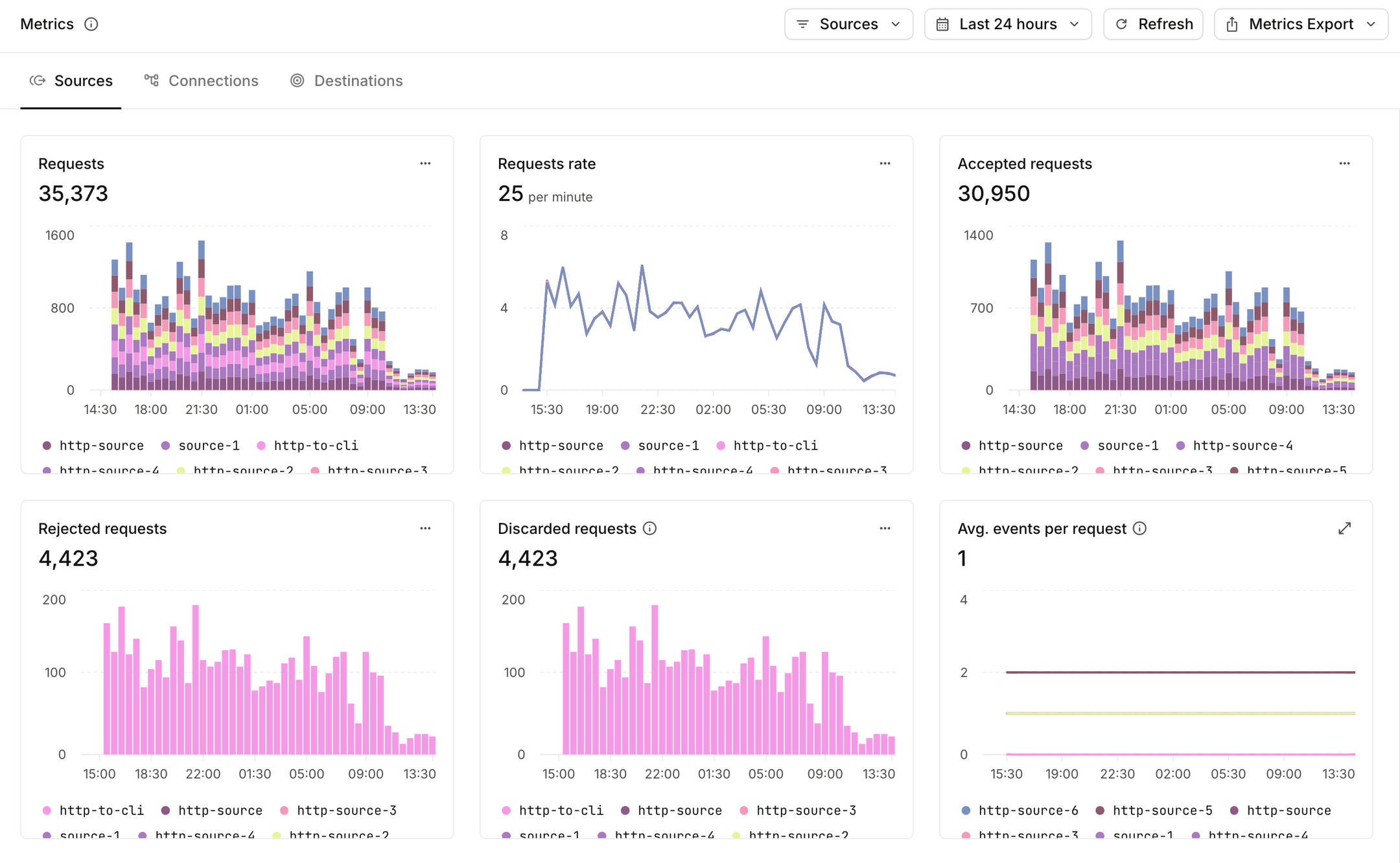
Hookdeck Event Gateway provides real-time event tracing with visual traces that show an event's full lifecycle from ingestion through transformation, filtering, and delivery. The dashboard includes success/failure rates, latency percentiles (average, p95, p99, max), and oldest event tracking. You get detailed logs with full-text search across your entire event history, the ability to filter by headers, query parameters, paths, errors, or JSON syntax, and bulk operations to pause, replay, or cancel events. Metrics export to Datadog, Prometheus, and New Relic is available on Growth plans and above.
Beyond raw event data, Event Gateway also has a structured Issues system. Rather than presenting a flat list of failed deliveries, Event Gateway can automatically create and track issues based on configurable issue triggers — for example, when a destination has consecutive failures, when a transformation errors, or when backpressure thresholds are exceeded. Each issue captures the root cause context, and your team can inspect it, take resolution steps, and update the issue status to keep everyone aligned. This turns webhook failures from a wall of error logs into a manageable operational workflow.
Convoy offers a basic dashboard showing events received. There are no latency percentiles, no visual event tracing, and no bulk operations. Metrics export is available via Prometheus, though this is still in beta for the receiving side. Convoy shows total events, successes/failures, and time in Convoy, but the observability depth doesn't extend to the kind of drill-down debugging Event Gateway provides. There is no equivalent to Event Gateway's issue tracking or custom issue triggers.
When something goes wrong with a webhook delivery, Event Gateway lets you trace the event visually, search across your full event history, inspect headers and payloads, see latency percentiles, bulk-replay failed events, and track the resolution through its Issues system. With Convoy, you're working with a basic events dashboard and Prometheus metrics in beta, with no structured way to track and communicate resolution across your team.
Alerting
When webhook deliveries fail, you need to know about it quickly.
Hookdeck Event Gateway can send alerts via Email, Webhooks, Slack, Microsoft Teams, PagerDuty, and OpsGenie, with custom triggers based on delivery failures, transformation errors, and backpressure thresholds. This means alerts can go directly to the on-call channel your team already uses, triggered by the specific conditions that matter to you.
Convoy supports alerting via Email and Webhooks, monitoring delivery failures only.
If your incident response workflow relies on Slack, PagerDuty, or OpsGenie, Event Gateway integrates natively. With Convoy, you'd need to build a webhook-to-Slack (or similar) integration yourself. Event Gateway's custom triggers also mean you can alert on transformation errors or backpressure — not just delivery failures.
Content type support
Hookdeck Event Gateway handles text, JSON, XML, form-encoded, JWT, multipart form-data, and binary content types. Binary bodies such as images, PDFs, and gzipped payloads are delivered byte for byte, and multipart fields are available to filters and transformations. This broad support matters because not every webhook provider sends JSON — some legacy systems use XML, JWT-based payloads are increasingly common, and file upload callbacks arrive as multipart form-data or raw binary.
Convoy supports JSON and form-encoded content only.
If every webhook provider you work with sends JSON, this won't matter. But if you're integrating with providers that send XML, JWT, plain text, multipart, or binary payloads, Convoy can't process them. You'd need to normalize those payloads into JSON before they reach Convoy, or handle the conversion downstream.
Retry logic and recovery
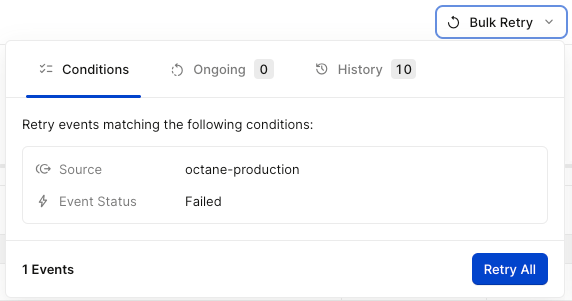
Hookdeck Event Gateway supports both linear and exponential backoff retry policies with customizable parameters, plus manual and bulk replay for recovering from outages. You can replay individual events or bulk-replay entire time ranges of failed deliveries, and pause/resume delivery to specific destinations.
Convoy also supports both linear and exponential backoff for automatic retries, and offers manual and bulk replay for failed deliveries.
The core retry and replay capabilities are comparable. Both products give you linear and exponential backoff options, manual retry for individual events, and bulk replay. Event Gateway adds the ability to pause/resume delivery to specific destinations, which is useful during planned maintenance or when a downstream service is being redeployed.
Signature verification
Both products verify the authenticity of incoming webhooks, but the supported authentication methods differ slightly.
Hookdeck Event Gateway supports HMAC, Basic Auth, Bearer Token, and API key verification.
Convoy supports HMAC, Basic Auth, and API key signature verification.
The difference is Bearer Token support in Event Gateway. If any of your webhook providers authenticate using Bearer Tokens, Event Gateway handles that natively while Convoy would require a workaround.
Developer tools
Hookdeck Event Gateway includes the Hookdeck Console with built-in sample webhooks from 60+ real providers for instant testing, and the Hookdeck CLI — a full-featured local development tool (often used as an ngrok alternative) with a terminal UI (TUI), event replay, and local forwarding.
Convoy has Playground for inspecting events, but with no sample webhook library, although it does have a CLI tool for local development.
The Console's sample webhooks from real providers save meaningful development time — you can test your handler against realistic payloads from Stripe, GitHub, Shopify, and dozens of other providers without setting up accounts or triggering real events. The CLI's TUI provides a rich local development experience, and the ability to route live webhook traffic to localhost with permanent URLs means your team can develop against real data without tunneling tools like ngrok.
Logging and search
Hookdeck Event Gateway provides advanced logging with full-text search and the ability to filter based on headers, query parameters, paths, errors, or JSON syntax. This means you can search for a specific customer ID across months of events, find all events with a particular error, or filter by any header value.
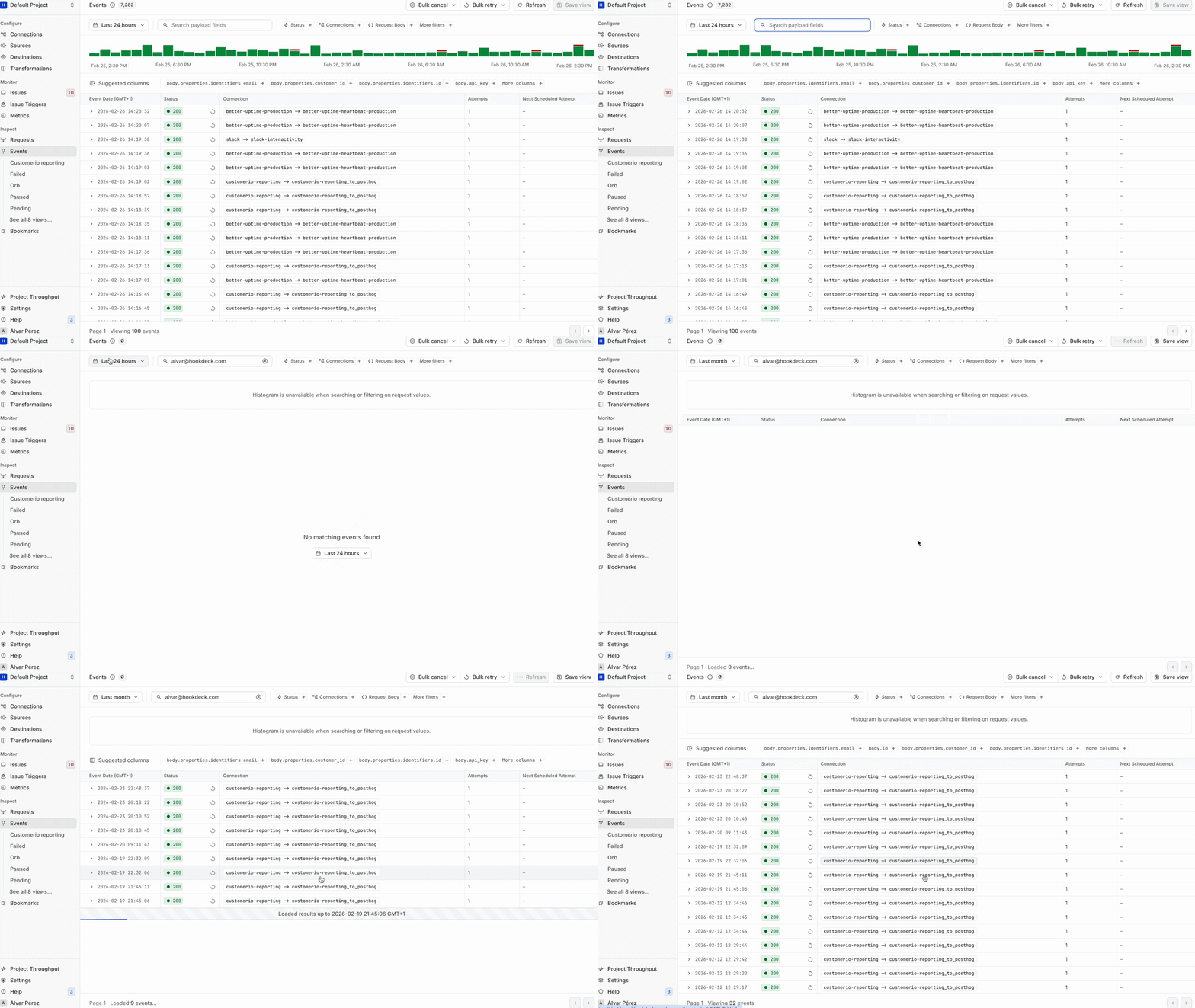
Convoy supports logging with filtering by date, owner ID, event type, and source. There is no full-text search capability.
The practical impact is most obvious during incident investigation. With Event Gateway, you can search across your entire event history using any field. With Convoy, you're limited to the four filter dimensions (date, owner, event type, and source) and need to browse through results manually.
Infrastructure-as-code
Hookdeck Event Gateway provides a Terraform provider and a full API and CLI for managing configuration programmatically.
Convoy provides an API for programmatic configuration but does not offer a Terraform provider and their CLI is focused on local development rather than infrastructure management.
If your team manages infrastructure with Terraform, Event Gateway fits into your existing workflow. With Convoy, you'd need to interact with the API directly or write custom Terraform modules wrapping the API.
Compliance and data residency
Hookdeck holds SOC 2 Type II, HIPAA, GDPR, CCPA, and PIPEDA certifications, and signs Business Associate Agreements (BAAs) for customers who need them. Event Gateway is currently hosted in the US only.
Convoy similarly holds SOC 2 Type II and GDPR certifications, but also offers hosting in EU as well as the US. It's worth validating whether you need EU data residency.
Uptime SLAs
Hookdeck Event Gateway offers a 99.999% uptime SLA across all paid plans.
Convoy offers tiered SLAs: 99.99% on Pro and 99.999% on Enterprise.
Event Gateway's 99.999% SLA is available starting from the Team plan at $39/mo. To get the same SLA from Convoy, you need to be on their Enterprise tier with custom pricing.
Pricing
Hookdeck Event Gateway pricing starts with a free tier (10K events, 3-day retention, 1 user), a Team plan at $39/mo with pay-as-you-go pricing ($0.33/100K events and unlimited users), and a Growth plan at $499/mo with SLAs and SSO.
Convoy Cloud starts at $99/mo for the Pro plan with 7-day retention and 25 events/sec throughput. There is no free cloud tier — though Convoy's open-source version can be self-hosted for free. Enterprise pricing is custom.
Event Gateway has a lower entry price ($39/mo vs $99/mo) and a free tier for getting started. Convoy includes SSO at $99/mo, while Event Gateway requires the $499/mo Growth plan for SSO. However, Convoy's Pro plan only offers 7-day data retention, while Event Gateway's Growth plan includes 30 days, which can be important for debugging and compliance.
Convoy's Pro plan includes 25 events/sec throughput, while Event Gateway's baseline is 5 events/sec with additional throughput available for purchase.
Deployment
Hookdeck Event Gateway is fully managed SaaS only. There is no self-hosted option.
Convoy is available as both a fully managed cloud service and a self-hosted deployment. The open-source version can be run on your own infrastructure for free.
This is Convoy's most significant advantage. For teams with strict data sovereignty requirements, air-gapped environments, or regulatory constraints that mandate on-premises deployment, Convoy's self-hosted option may be the deciding factor. Event Gateway's managed service is SOC 2, HIPAA, GDPR, and CCPA compliant, which satisfies most compliance requirements — but it can't address a hard requirement for on-premises deployment.
When to choose Hookdeck Event Gateway
Event Gateway is the stronger choice when you need deep observability and debugging across your webhook traffic (visual tracing, latency percentiles, metrics export), when you're integrating with many different providers (160+ pre-configured sources vs 3), when you need field-based deduplication and advanced filtering at the infrastructure level, when you process webhooks for many tenants and need per-tenant delivery rates, when you deal with non-JSON payloads (XML, JWT, form-data, plain text), when you want a rich local development experience with the CLI and Console, or when you want production-grade features at an accessible price point starting at $39/mo with a free tier.
When to choose Convoy
Convoy may be the right choice if you need to self-host your webhook infrastructure or host it in the EU for data sovereignty or regulatory reasons, if you need both sending and receiving in a single unified gateway, if SSO at a lower price point ($99/mo vs $499/mo) is a priority, or if the higher base throughput (25 events/sec vs 5 events/sec) matters at your entry tier.
Conclusion
Both Hookdeck Event Gateway and Convoy can receive webhooks and forward them to your services. The difference is in the depth of what happens in between. Event Gateway provides a purpose-built inbound webhook platform with durable queueing, per-tenant delivery rates, advanced filtering, field-based deduplication, visual tracing, full-text search, structured issue tracking, and broad content type support. Convoy provides a unified gateway that handles incoming webhooks alongside outbound delivery, with basic observability and a self-hosted deployment option.
For teams that treat inbound webhooks as critical infrastructure (where missed events, duplicate processing, and limited visibility are real operational risks) Event Gateway offers significantly more depth. For teams that need self-hosted deployment, EU data residency, or prefer a single tool for both sending and receiving, Convoy provides a simpler, unified alternative.
Resources
FAQs
When is Hookdeck Event Gateway a better fit than Convoy?
Event Gateway is the better choice when you need deep observability (visual traces, full-text search, automated issue tracking), integrate with many webhook providers (160+ pre-configured sources vs 3), require advanced filtering and field-level deduplication, need per-tenant delivery rates for multi-tenant workloads (Delivery Groups), process non-JSON payloads, or want Infrastructure-as-Code support via Terraform. It's also significantly more mature for inbound-specific use cases.
When is Convoy a better fit than Hookdeck Event Gateway?
Convoy may be a better fit if you need a self-hosted open-source solution you fully control, require EU data residency, want a unified platform that handles both sending and receiving webhooks in a single product, or need SSO at a lower price point ($99/month vs $499/month for Event Gateway's Growth tier).
What are the tradeoffs between managed and open-source webhook receiving?
Managed platforms like Hookdeck Event Gateway provide deep observability, 160+ pre-configured sources, and zero infrastructure maintenance — but require trusting a third party with your event data. Self-hosted options like Convoy give you full control and data sovereignty, but require your team to handle deployment, scaling, monitoring, and upgrades. Most teams find the operational cost of self-hosting outweighs the control benefits unless they have strict data residency or compliance requirements.
Which is better for multi-tenant webhook delivery?
Hookdeck Event Gateway. Delivery Groups give each tenant its own delivery rate by keying on a field in the webhook (a store ID, account ID, or tenant header), with fair scheduling across active groups, per-group overrides, and group-level metrics and backpressure alerts. Convoy's rate limiting applies per endpoint, so one tenant's burst shares the same limit as everyone else's traffic.
