Changelog

New features, improvements, and fixes across Event Gateway, Outpost, and the Hookdeck platform.

  1. MCP events

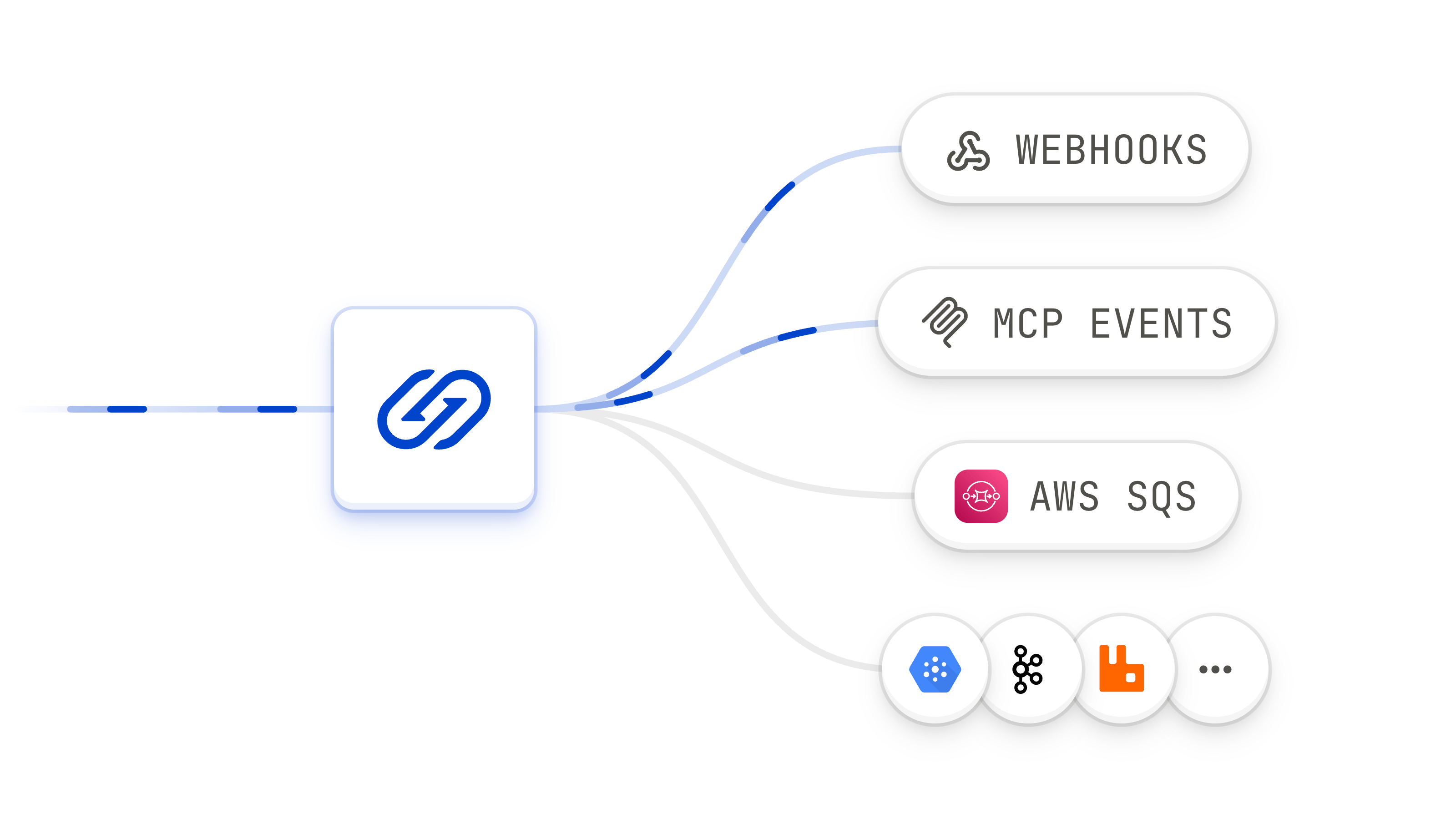
    As of v1.9.0, Outpost can be the backend for MCP Events, the draft MCP extension that lets an agent subscribe to events from your MCP server and receive them as webhooks. Your MCP server forwards events/list, events/subscribe and events/unsubscribe to Outpost, and Outpost verifies the callback URL, stores the subscription, and signs, filters and delivers each matching event.

    What's new

    Agents connected to your MCP server can list your event types and subscribe to one, with arguments that filter on payload fields. Outpost delivers matching events straight to the agent's callback URL, signed with Standard Webhooks. Deliveries don't pass through your MCP server.

    Publishing doesn't change. One publish reaches every matching subscription for that tenant, and a tenant's topics include the events its agents subscribe to.

    To try it locally, mcp-dev runs a reference MCP server, receiver and client with sample events, and mcp-dev check tests any MCP Events server against the spec.

    Limitations

    For now, MCP Events is experimental and off by default. Since the spec is still a draft, details such as error codes may change. Delivery is webhook mode only, matching what ChatGPT supports: there's no poll or streaming delivery and no cursor replay.

  2. Faster retries

    Retries are now faster and bursts of retries no longer swamp the log store.

    Before each retry, Outpost looks up the latest delivery attempt for the event and destination. On ClickHouse, that lookup used to read more data the longer you kept logs. It now starts from the time of the attempt that failed, so its cost no longer grows with retention. With 8 million attempts over 30 days, one lookup dropped from about 300 ms of ClickHouse CPU to about 14 ms.

    The scheduler now runs at most RETRY_MAX_CONCURRENCY retries at once per process (default 100) and adds jitter to its backoff, so failed lookups don't all come back at the same moment. Set RETRY_LOOKUP_BATCH_SIZE to combine the lookups of retries running at the same time into one query. In our tests, a batch size of 50 cut the ClickHouse CPU spent on lookups by about three quarters. CLICKHOUSE_MAX_OPEN_CONNS, CLICKHOUSE_DIAL_TIMEOUT_SECONDS and CLICKHOUSE_READ_TIMEOUT_SECONDS tune the ClickHouse connection pool, with defaults unchanged.

    Available now in v1.7.0.

  3. NATS JetStream

    Self-hosted Outpost can now use NATS JetStream for its internal delivery and log queues, alongside RabbitMQ, AWS SQS, GCP Pub/Sub and Azure Service Bus. Set NATS_SERVER_URL to enable it.

    Stream, subject and dead-letter subject names can be overridden with the NATS_* variables. NATS servers limit messages to 1 MiB by default, so raise max_payload if you deliver larger events. See bring your own message queues.

    Thanks to @rohanshirsath-droadmap for contributing NATS JetStream support. It's available now in v1.6.0.

    New destinations

    Your tenants can now receive events on two new destination types:

    • AWS EventBridge (aws_eventbridge): publishes to an event bus, with the event topic as the detail type. Self-hosted deployments can set the Source with DESTINATIONS_AWS_EVENTBRIDGE_SOURCE (default outpost).
    • Cloudflare Queues (cloudflare_queues): publishes to a queue through the Cloudflare HTTP API, authenticated with a Cloudflare API token.

    Create them through the API like any other destination type.

    Thanks to @pryzmatical for contributing the AWS EventBridge destination. Both destinations are available now in v1.6.0.

    Destination proxies

    Self-hosted Outpost can now route webhook, RabbitMQ and Kafka destination connections through an HTTP CONNECT proxy, so destinations that allowlist source IPs see the proxy's address. Set DESTINATIONS_PROXY_URL to a proxy URL, or to several whitespace-separated URLs to chain proxies in order. TLS runs end to end between Outpost and the broker.

    The same applies to ingestion: PUBLISH_PROXY_URL routes a RabbitMQ publish queue connection through a proxy chain in the same format.

    DESTINATIONS_WEBHOOK_PROXY_URL is deprecated but still works, and overrides the new variable for webhooks. See the forward proxy guide.

    Destination proxies are available now in v1.6.0.

  4. Delivery latency

    Outpost now records latency_ms on every delivery attempt: the time the destination took to respond or fail.

    GET /metrics/attempts adds avg_latency, p50_latency, p95_latency and p99_latency measures. They work with the existing dimensions, filters and granularity, so you can chart response times per tenant or destination, or find the destinations that are slowing down. Failed attempts count too, so filter by status to look at successful deliveries only.

    Attempts recorded before latency tracking return null. See metrics.

    Thanks to @kunwar-axilio for contributing delivery latency tracking. It is available now in v1.5.0.

  5. Compat signatures

    Outpost can now send a second signature in your previous format alongside the primary one. Receivers keep verifying the old headers and switch to the new scheme on their own schedule.

    Use it when you're moving to Outpost from a webhook system you built yourself or from another provider, or when you're changing the signature scheme of a running deployment. Set DESTINATIONS_WEBHOOK_COMPAT_SIGNATURE_HEADER_NAME to enable it, and configure the content template, encoding, algorithm and extra headers with the other DESTINATIONS_WEBHOOK_COMPAT_* variables. Both signatures use the same destination secret, so receivers keep their existing secret. Nothing changes until the header name is set.

    The compat signature also works in Standard Webhooks mode. See the change webhook signature scheme guide. It's available now in v1.4.0.

  6. Operator Events

    Outpost now supports Operator Events in v0.17.1, so you can subscribe to deployment lifecycle signals like delivery failures, destination auto-disable, exhausted retries, and tenant subscription changes.

    • Topics: Subscribe to specific topics (or *) including alert.destination.consecutive_failure, alert.destination.disabled, alert.attempt.exhausted_retries, and tenant.subscription.updated
    • Consistent envelope: Events include id, topic, time, deployment_id, tenant_id, and topic-specific data