What is a Webhook Gateway?
Webhooks have become an essential component of modern software systems, enabling inter-service communication between services and applications by delivering event-driven notifications over HTTP. However, as systems grow in complexity, managing these webhooks can become challenging. This is where a Webhook Gateway comes into play.
Defining a Webhook Gateway
A webhook gateway is a centralized service or layer that manages webhooks. A webhook gateway abstracts the infrastructure challenges of webhook management, allowing developers to focus on building application logic rather than dealing with technical pitfalls like retries, timeouts, or security vulnerabilities.
There are two schools of thought when it comes to the directionality of the webhooks:
- Receive Webhooks only: Similar to an API Gateway, a webhook gateway manages the sending and delivery of webhook events between systems.
- Send and Receive Webhooks: A webhook gateway manages the sending, receiving, and delivery of webhook events between systems.
In either case, a webhook gateway acts as an intermediary, handling the complexities of webhook communication while providing features like security, reliability, scalability, and observability.
Key Responsibilities of a Webhook Gateway
- Reliable Event Ingestion Webhooks are quickly and reliably ingested by the gateway, ensuring the HTTP request does not timeout and no events are lost, even during high traffic periods.
- Reliable Event Delivery Webhooks rely on HTTP, which is inherently unreliable. A webhook gateway ensures reliable delivery through mechanisms like retries, configurable backoff strategies, and failure tracking. If an endpoint is temporarily unavailable, the gateway retries until the event is successfully delivered or an acceptable threshold is reached. Reliable event delivery is important no matter the webhook direction:
- Receive Webhooks only: When delivering an event received from a third-party such as Shopify or Stripe to an internal API.
- Send and Receive Webhooks When delivering events to a webhook endpoint provided to your platform by a developer.
- Security and Authentication To prevent unauthorized access or tampering, webhook gateways include features like:
- HMAC signature validation to ensure payload integrity.
- TLS encryption to secure data in transit.
- Support for authentication mechanisms like API keys or OAuth. For a deeper look at how a gateway centralizes security across all your providers, see our guide to webhook gateway security architecture.
- Scalability As your system grows, the volume of webhooks can become overwhelming. A webhook gateway scales to handle a large number of events and connections, ensuring your system performs consistently under load.
- Rate Limiting and Throttling To prevent overwhelming downstream systems, a webhook gateway enforces rate limits and throttles outgoing webhook requests. This protects external APIs from excessive load.
- Observability and Monitoring A webhook gateway provides insights into webhook performance, success rates, latency, and failures. It enables teams to debug issues efficiently and optimize their systems.
- Transformation and Filtering Some webhook gateways allow you to modify payloads or filter events before forwarding them. This can help tailor webhook data to the needs of downstream systems.
- Fan-Out and Routing A webhook gateway can duplicate a single inbound event and deliver it to multiple downstream destinations independently. This enables you to route events from different providers to different services, or fan out a single event to multiple consumers, all without writing routing logic in your application code.
Why Use a Webhook Gateway?
If your system relies heavily on webhooks, managing them without a gateway can lead to various challenges:
- Scaling Issues: A sudden spike in events can overwhelm your application or external APIs.
- Debugging Complexity: Without centralized monitoring, identifying and fixing webhook failures can be time-consuming.
- Security Risks: Manually handling security increases the risk of vulnerabilities. This problem can be amplified when handling webhooks from multiple providers with different security mechanisms.
- Operational Overhead: Building reliable retry mechanisms and managing webhook delivery can consume significant development resources.
A webhook gateway simplifies these challenges, enabling you to build resilient, secure, and scalable systems without reinventing the wheel. For most teams, the tipping point comes faster than expected. Once you're integrating with three or more webhook providers, processing business-critical events, or spending meaningful engineering time on retry logic and debugging, a managed webhook gateway like Hookdeck Event Gateway pays for itself quickly. Thousands of teams use Event Gateway to process billions of webhook events with 99.999% uptime.
How Does a Webhook Gateway Work?
A typical webhook gateway operates as follows:
- Event Generation: An external service or your own application generates an event.
- Event Ingestion: The webhook gateway receives the HTTP request, verifies the sender's identity (signature verification, API key, etc.), and acknowledges receipt immediately.
- Event Enqueueing: The verified event is placed into a durable queue, decoupling ingestion from processing. This ensures events are not lost if downstream services are slow or unavailable.
- Event Processing: Optional transformations or filtering occur before delivery. Payloads can be normalized, irrelevant events can be dropped, and events can be duplicated for fan-out to multiple destinations.
- Delivery Management: The gateway delivers events to subscriber endpoints, retrying with configurable backoff when delivery fails.
- Logging and Metrics: All webhook activity is logged, and metrics are generated for monitoring, alerting, and debugging.
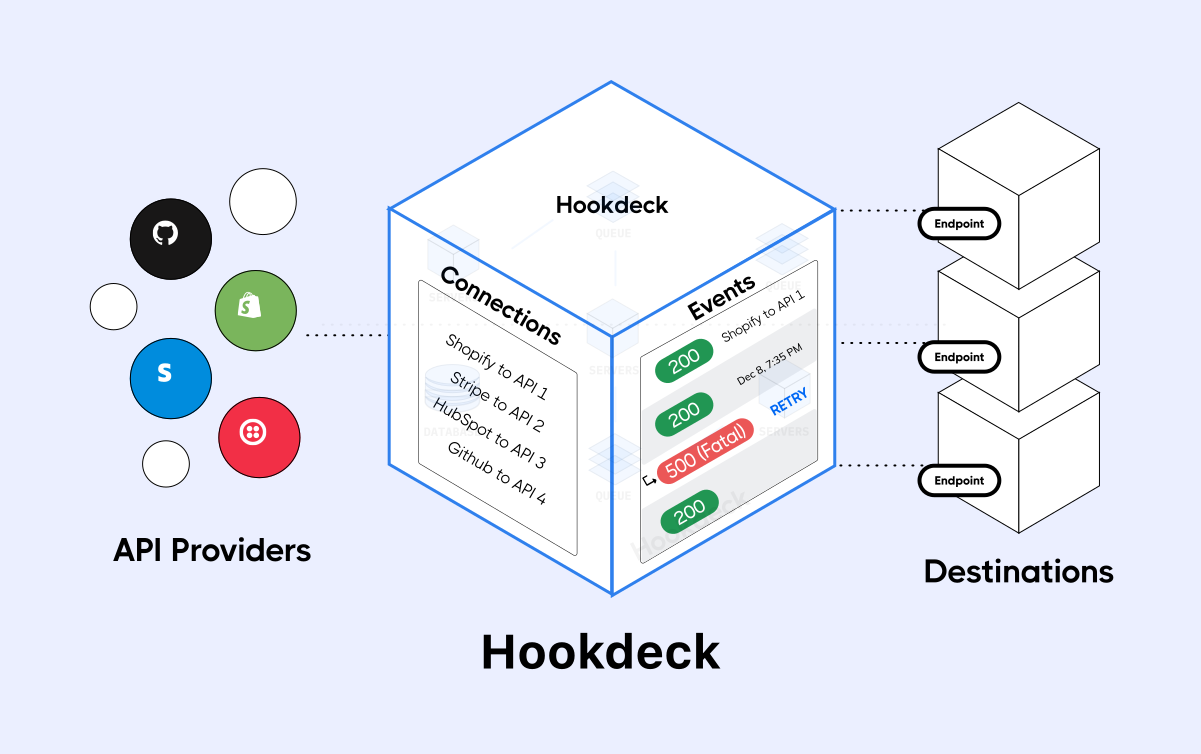
The following diagram shows how webhook events flow through a gateway — from API providers through ingestion, queueing, and processing, to delivery at your endpoints:
What a webhook gateway replaces
Without a gateway, teams typically assemble this infrastructure from individual components — an API gateway or ingestion service (Cloudflare, AWS API Gateway, Lambda), a message queue (PubSub, RabbitMQ, SQS, Kafka), storage (S3, Elastic Search), consumer workers (Kubernetes, VMs, serverless functions), plus custom tooling for error recovery, logs, and alerts.
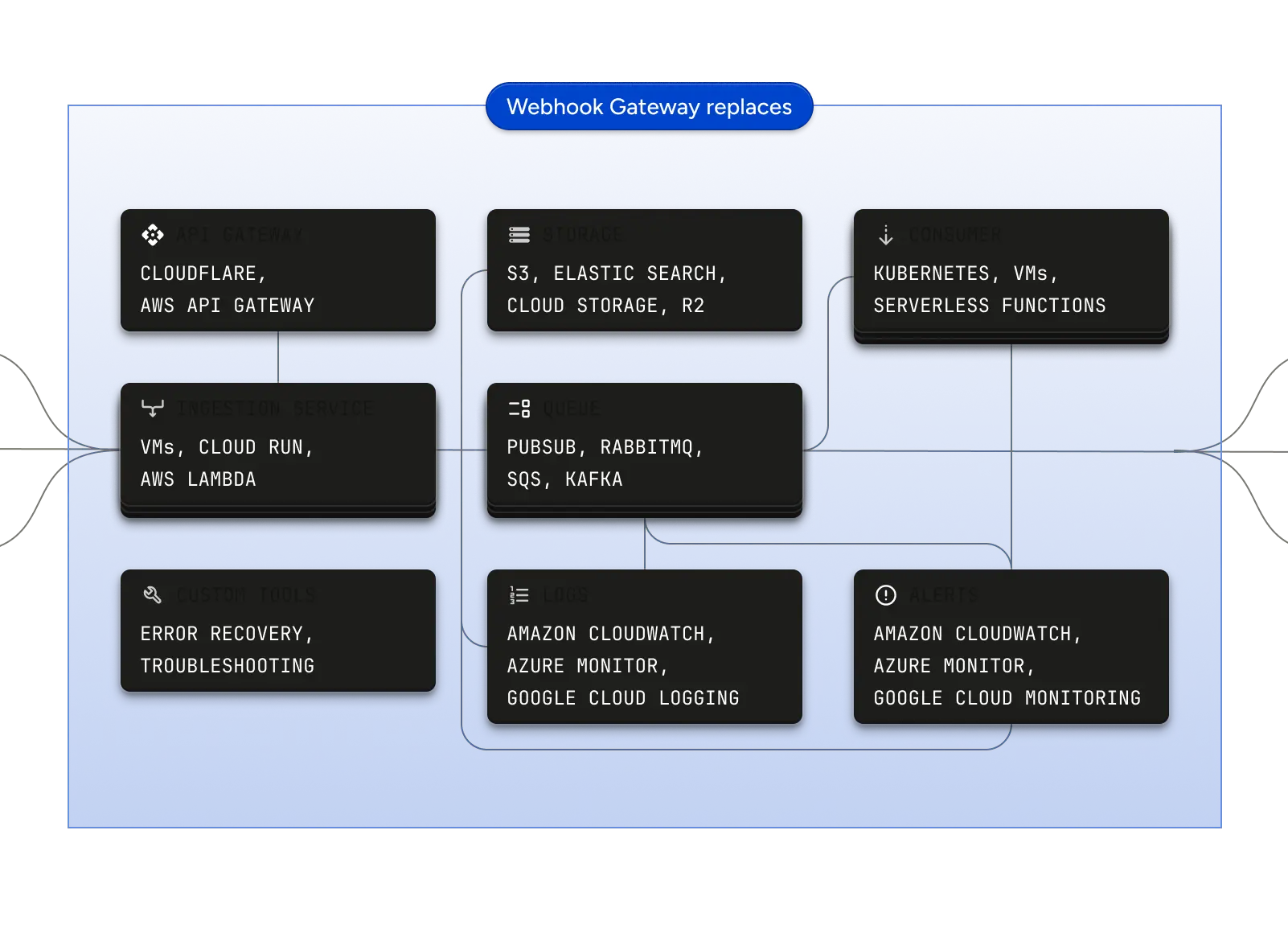
A webhook gateway consolidates all of these into a single managed layer, eliminating the operational burden of deploying, scaling, and maintaining each component independently. For a detailed breakdown of the architectural requirements behind this infrastructure, see our guide on webhook infrastructure requirements and architecture.
Webhook Gateway vs. API Gateway
Webhook gateways and API gateways are often confused because both sit between external services and your application. The critical difference is the communication model they manage.
An API gateway handles synchronous, request-response traffic. A client sends a request, the gateway authenticates and routes it, the backend processes it, and the response travels back. If the backend is down, the client gets an error immediately. The gateway is stateless. It doesn't store requests or retry failed deliveries.
A webhook gateway handles asynchronous, event-driven traffic. An external service pushes an event, the gateway ingests it, queues it, and delivers it to your backend independently. If the backend is down, the event is retained and retried. The gateway is durable. Events are never lost due to downstream failures.
| Capability | API Gateway | Webhook Gateway |
|---|---|---|
| Communication model | Synchronous request-response | Asynchronous event push |
| Traffic direction | Client → Gateway → Backend | Provider → Gateway → Backend |
| Failure handling | Returns error to client | Queues event, retries delivery |
| Rate limiting | Rejects excess requests (429) | Accepts all events, throttles delivery |
| Authentication | Validates client credentials | Verifies provider signatures |
| Queueing | No (stateless pass-through) | Yes (durable event queue) |
| Deduplication | Not typically | Yes (exact and field-based) |
| Event replay | No | Yes (bulk replay for recovery) |
Most production systems that integrate with external services need both. The API gateway manages your outward-facing API traffic; the webhook gateway manages your inward-facing event traffic. The mistake teams commonly make is routing webhooks through their API gateway. API gateways aren't designed for the durability, queueing, and retry semantics that webhook traffic requires.
For a full breakdown with real-world examples, see our dedicated guide on webhook gateway vs. API gateway differences.
When NOT to Use a Webhook Gateway
A webhook gateway adds a layer to your architecture, and not every team needs one. Here are scenarios where it may not be the right choice:
One or two low-volume integrations: If you receive webhooks from a single provider at low volume (a few hundred events per day), a simple endpoint with basic signature verification and try/catch error handling may be sufficient. The operational overhead of a gateway doesn't justify itself until you have multiple providers or meaningful volume.
No reliability requirements: If the webhooks you're receiving are purely informational and a missed event has no business consequence — analytics pings, non-critical notifications, development-only logging — the durability guarantees of a gateway may be unnecessary.
Fully serverless with built-in queueing: If your architecture already routes all inbound HTTP traffic through a managed queue (e.g., API Gateway to SQS to Lambda on AWS), you already have a basic ingestion-and-queue pattern. A dedicated webhook gateway becomes valuable when you outgrow this pattern, when you need per-provider signature verification, filtering, fan-out, observability, or multi-destination routing that the generic queue setup doesn't provide.
You only send webhooks (outbound): Webhook gateways focused on receiving inbound webhooks don't help if your use case is purely outbound, sending webhooks to your customers' endpoints. For that, you need an outbound webhook delivery platform (such as Hookdeck Outpost).
Budget and team constraints: If your team is very small and your webhook volume is minimal, the time spent setting up and learning a gateway might be better spent elsewhere. As your integrations and volume grow, revisit the decision — most teams reach the tipping point faster than they expect.
In general, once you're integrating with three or more webhook providers, processing business-critical events (payments, orders, user actions), or spending meaningful engineering time maintaining retry logic and debugging delivery failures, a webhook gateway pays for itself quickly.
How to Evaluate a Webhook Gateway
Not all webhook gateways offer the same depth of features. When evaluating solutions, these are the capabilities that matter most once your webhook traffic becomes critical infrastructure:
Reliable ingestion with queueing. When your downstream services are slow or unavailable, the gateway should buffer incoming webhooks in a durable queue rather than dropping them. Look for backpressure handling that prevents traffic spikes from overwhelming your application.
Pre-configured source verification. Every webhook provider authenticates differently: HMAC, Basic Auth, Bearer Token, API key. The more providers a gateway supports out of the box, the less per-provider implementation work for your team. Hookdeck Event Gateway supports 160+ pre-configured sources.
Filtering and deduplication. Not every event is relevant, and duplicate deliveries are common. Infrastructure-level filtering and deduplication reduces noise before events reach your application code.
Routing and fan-out. As your integrations grow, you need to route events from different providers to different services, and fan out a single event to multiple destinations. Look for conditional routing based on payload content, not just event type.
Transformations. Different providers send different payload formats. The ability to normalize events into a consistent structure before delivery simplifies downstream processing.
Observability and debugging. When something goes wrong, you need to trace an event's lifecycle, search across your event history, and understand why a delivery failed. Visual tracing, full-text search, and structured issue tracking turn webhook failures from generic error logs into a manageable workflow.
Alerting. Integration with your existing incident response tools (Slack, PagerDuty, OpsGenie) so you know about failures before your customers do.
Retries and recovery. Automatic retries with configurable backoff handle transient failures. Bulk replay handles extended outages — the ability to select a time range of failed events and replay them all at once.
Developer tools. A CLI for local development, sample webhooks for testing, and a console for inspecting events in real time all reduce the time from integration to production.
For a deeper understanding of how delivery semantics shape your infrastructure decisions, see our webhook delivery guarantees guide.
Popular Webhook Gateway Solutions
There are a growing number of solutions available that provide webhook gateway functionality:
- Hookdeck Event Gateway: Focuses on reliable webhook ingestion, observability, and error handling for engineering teams dealing with large-scale webhook traffic.
- Svix: Most commonly used by API platforms for outbound webhooks.
- Convoy: Source-available, cloud-native webhooks gateway.
- Zapier and Make: Although considered more low-code/no-code iPaaS solutions than webhook gateways, these well-known platforms can receive webhooks and trigger outbound webhooks.
Alternatively, some teams choose to build their own webhook gateway tailored to their specific needs, though this can be resource-intensive. For guidance on how to migrate from a DIY setup to a managed gateway, see our migration guide.
For more on choosing the right solution, see our guide to taking control of your webhook reliability.
Conclusion
A webhook gateway provides infrastructure for managing the complexities of webhook-based communication. It ensures reliable delivery, enhances security, scales with your system, and provides the observability needed to troubleshoot effectively. Thousands of teams rely on Hookdeck Event Gateway to handle this complexity — with 160+ pre-configured sources, durable queueing, and the observability to finally see what's happening with your webhooks.
For more on designing your infrastructure, see our webhook infrastructure requirements and architecture guide. To understand how a gateway's security model works across providers, see webhook gateway security architecture. Whether you choose a third-party solution or build your own, adopting a webhook gateway is a step toward building reliable and scalable event-driven systems.
FAQs
What is a webhook gateway?
A webhook gateway is a centralized service that sits between webhook producers (like Stripe, Shopify, or GitHub) and your application. It handles ingestion, queueing, routing, transformation, and delivery of webhook events — abstracting away infrastructure challenges like retries, timeouts, security verification, and observability so developers can focus on application logic.
When does a team need a webhook gateway?
Consider a webhook gateway once you integrate with three or more webhook providers, spend meaningful engineering time on retry logic and debugging, or need reliability guarantees like durable queueing and delivery confirmation. If a missed webhook means lost revenue, broken workflows, or frustrated users, a gateway removes that risk.
How is a managed webhook gateway different from building your own?
Building your own requires combining an API gateway, message queue, worker services, storage layer, and monitoring — each with their own operational burden. A managed gateway like Hookdeck Event Gateway consolidates all of this into a single service with 160+ pre-configured sources, durable queueing with backpressure, and built-in observability, deployable in minutes rather than months.
Can a webhook gateway handle burst traffic?
Yes. A well-designed webhook gateway uses durable queueing with backpressure to absorb traffic spikes without overwhelming your downstream services. Events are persisted and delivered at a rate your application can handle, preventing data loss during surges.
Does a webhook gateway support retries, replay, and transformations?
Yes. Core webhook gateway capabilities include automatic retries with configurable backoff strategies, manual replay of failed events, and payload transformations (filtering, reformatting, enrichment) before delivery. These features eliminate the need to build and maintain this logic in your own application code.
Webhook infrastructure, managed for you
Hookdeck handles ingestion, delivery, observability, and error recovery — so you don't have to.