What is an Event Gateway? The Definitive Guide

Whatever you're building, there's a good chance at least part of it is event-driven. Whether you're integrating with a few external APIs or orchestrating a full microservices architecture, you need a reliable way to ingest, process, route, and deliver events.
Most teams start by chaining standalone tools — an API gateway here, a message queue there, some custom retry logic, a few monitoring dashboards. It works until it doesn't. As integrations multiply, the infrastructure you built to manage your events starts demanding more attention than the events themselves.
An event gateway solves this by consolidating the entire event lifecycle into a single platform. This guide covers what an event gateway is, why the category exists, what it can do, how it compares to adjacent technologies, and how to evaluate whether one is right for your architecture.
What is an Event Gateway?
Event Gateway Definition
An event gateway is a platform that sits at the center of your event-driven architecture and manages the full lifecycle of events flowing between services. It combines selective functionality from API gateways, message queues, event processing tools, and message brokers into a single system that ingests, queues, filters, transforms, routes, and reliably delivers events.
Think of it as a combination of air traffic control and a logistics network for your events. Events enter the gateway from external providers, internal services, or asynchronous API endpoints. The gateway verifies their origin, applies filtering and transformation rules, routes them to the correct destinations, and guarantees delivery — with automatic retries, replay, and end-to-end observability built in.
The key distinction from other tools in the event-driven ecosystem is scope. An API gateway manages synchronous request-response traffic. A message broker provides raw messaging primitives for internal service-to-service communication. An event gateway manages the complete event lifecycle across system boundaries — including the integration logic, delivery guarantees, and operational visibility that would otherwise require assembling and maintaining multiple tools.
Not to Be Confused With: BPMN Event-Based Gateways
The term "event gateway" also appears in Business Process Model and Notation (BPMN), where it refers to something entirely different. A BPMN event-based gateway is a process modeling construct that represents a branching point where the next step in a workflow depends on which event occurs first — for example, waiting for either a payment confirmation or a timeout, and proceeding down whichever path triggers first.
This guide is about event gateways in the infrastructure sense: platforms that manage the flow of events between services in an event-driven architecture.
Why Event Gateways Exist: The Problem They Solve
Event gateways emerged because the existing toolkit for managing event-driven architectures requires teams to assemble and maintain multiple components that weren't designed to work together.
The Fragility of Chaining Standalone Tools
A typical event-driven architecture cobbled together from individual tools looks something like this: an API gateway or ingestion service to accept inbound events over HTTP, a message queue (SQS, RabbitMQ, Kafka) to buffer them, custom code to verify signatures from each provider, consumer workers to process events, additional services for transformation and enrichment, dead letter queues for failure management, custom retry logic, and one or more observability tools to monitor the whole chain.
Each component works well in isolation. The problem is the integration points between them. Every connection is a potential failure mode. Every tool has its own configuration, scaling behavior, and monitoring interface. When an event fails to deliver, diagnosing whether the problem was in the ingestion layer, the queue, the transformation logic, or the delivery service requires correlating data across multiple systems.
As integrations multiply, this fragility compounds. Adding a new webhook provider means writing new verification code, updating routing logic, and extending monitoring coverage. A deployment that disrupts one component can cascade failures across the chain. The infrastructure you built to manage events becomes its own operational burden.
The Operational Burden of DIY Event Infrastructure
Beyond fragility, there's the sheer operational cost. Teams that build their own event infrastructure report spending significant engineering time on concerns that aren't core to their product:
- Writing and maintaining provider-specific signature verification for each webhook source
- Building retry logic with configurable backoff — and then building the monitoring to know when retries are failing
- Managing dead letter queues and writing scripts to inspect and reprocess failed events
- Implementing rate limiting to protect downstream services from traffic spikes
- Building dashboards that correlate events across ingestion, processing, and delivery stages
- Scaling each component independently during traffic spikes
An event gateway consolidates all of these into a single platform, replacing the DIY integration layer with managed infrastructure that handles the operational concerns so your team can focus on application logic. For a detailed walkthrough of how an event gateway addresses each of these challenges, see Overcoming Event-Driven Architecture Complexity with an Event Gateway.
Core Capabilities of an Event Gateway
Event Ingestion
An event gateway provides stable HTTP endpoints for each event source — whether that's an external webhook provider like Stripe or Shopify, an internal service publishing events, or an asynchronous API endpoint accepting data from clients and devices.
Events are acknowledged immediately at the point of receipt and persisted to durable storage before any processing begins. This decouples ingestion from downstream processing, meaning traffic spikes, slow consumers, or temporary outages don't cause event loss. The producer receives its acknowledgment and moves on; the gateway takes custody of the event from that moment forward.
Because the gateway operates over HTTP natively, there's no protocol translation layer to build — unlike routing events through a message broker, which typically requires a separate API gateway or custom service to convert HTTP requests into the broker's native protocol.
Filtering and Routing
Not every event is relevant to every destination. An event gateway applies filter rules that evaluate event metadata, headers, and payload content — suppressing irrelevant events before they consume downstream resources.
Routing rules determine which events reach which destinations. A single event can be fanned out to multiple services based on its source, type, or content. Adding a new destination is a configuration change, not a code deployment. This means teams can extend integrations, add new consumers, or restructure event flows without touching application code — the gateway handles the dispatch logic at the platform level.
Transformation
External systems and internal services rarely agree on event schemas. A payment processor sends one payload format, a logistics partner sends another, and your internal consumers expect a third.
An event gateway applies transformations between ingestion and delivery — restructuring payloads, renaming fields, flattening nested objects, converting data types. The consumer receives events in the shape it expects, regardless of which system produced them. This eliminates the custom adapter services that otherwise accumulate between every pair of systems exchanging events.
Reliable Delivery and Retries
The gateway owns delivery end-to-end. When a destination is unreachable, events are automatically retried on a configurable schedule with exponential backoff. Persistently failing deliveries surface as structured, searchable issues — not silent entries in a log file that someone has to remember to check.
When a downstream service has an extended outage, bulk replay provides recovery: select a time range and replay all affected events after the service recovers. This is a first-class operation — an API call or dashboard action — rather than a manual reprocessing project involving DLQ scripts and offset management.
These delivery guarantees mean that deployment windows, temporary downtime, and transient network issues never result in lost events. For more on delivery reliability, see our guide to webhook delivery guarantees.
Observability and Monitoring
Every event's journey is tracked from ingestion through delivery: when it arrived, which filters and transformations were applied, where it was routed, how many delivery attempts were made, and the outcome of each.
This integrated lifecycle view replaces the work of correlating metrics from a message broker, application logs from your services, and traces from an external monitoring tool. When something goes wrong, you search for the event and see its complete history in one place. For a deeper look at observability architecture, see our guide to webhook observability.
Alerting integrations with tools like Slack, PagerDuty, and OpsGenie mean your team knows about delivery failures before downstream consequences surface.
Security and Verification
Every event source authenticates differently. Stripe signs payloads with HMAC-SHA256. GitHub uses a shared secret header. Shopify rotates API keys. Each provider has its own scheme, and implementing verification logic per integration is both tedious and security-critical.
An event gateway centralizes source verification at the platform level, validating each provider's authentication scheme before events enter your pipeline. Your application code never touches raw signature verification — that concern is handled at the infrastructure layer.
Event Gateway Use Cases
Let's get into some of the ways you can put an event gateway to work.
Inbound Webhook Infrastructure
Managing a few webhooks is simple. But as you add more providers — payment processors, e-commerce platforms, CI/CD systems, communication tools — you need queuing, routing, verification, and retry mechanisms to give you the certainty your business requires.
An event gateway provides all of this as managed infrastructure. Events from Stripe, Shopify, GitHub, Twilio, and dozens of other providers are ingested through gateway-managed endpoints, verified using each provider's authentication scheme, filtered, and delivered to your services — with full observability and automatic recovery from failures.
Outbound Webhook Infrastructure
Enabling your customers to subscribe to events and receive them via outbound webhooks introduces its own complexity: managing subscriptions, handling per-customer retry logic, enforcing rate limits, and providing delivery visibility.
An event gateway handles this on your behalf. You publish events to the gateway, and it manages authentication, delivery scheduling, retries, and monitoring for every subscriber endpoint. This frees your team to focus on what events to send rather than the infrastructure to deliver them.
Asynchronous API Gateway
Ingesting events securely from devices, SDKs, and other types of clients is a significant scalability challenge. By decoupling the system ingesting API requests from the services doing the asynchronous work, an event gateway absorbs traffic spikes at the ingestion layer and delivers events to backend services at a controlled pace.
This works differently from a synchronous API gateway — the event gateway doesn't return the processing result to the caller. Instead, it acknowledges receipt immediately and handles routing, transformation, and delivery asynchronously, providing observability and logging benefits similar to an API gateway but optimized for event-driven patterns.
Third-Party Service Integration
When independent systems need to communicate — and they weren't designed to talk to each other — an event gateway provides the intermediary layer. It receives events from one system, transforms payloads to match what the receiving system expects, applies routing rules, and delivers events reliably.
This is particularly valuable for connecting systems where you don't control the producer's event format, authentication scheme, or delivery behavior. The gateway absorbs the heterogeneity at the integration boundary so your internal services don't have to. For practical examples of how transformation and routing simplify third-party integration, see Overcoming Event-Driven Architecture Complexity with an Event Gateway.
Serverless Messaging
In serverless architectures, functions and services are ephemeral — they spin up on demand and disappear when idle. They can't maintain persistent connections to a message broker or subscribe to topics across invocations.
An event gateway acts as the central hub for asynchronous communication in serverless environments, providing reliable, at-least-once delivery of messages between functions and third-party services without requiring you to manage messaging infrastructure.
Event Gateway vs. API Gateway
An API gateway manages synchronous, request-response traffic — the client sends a request, the backend processes it, and the response returns in the same connection. It's stateless: if the backend is unavailable, the client gets an error.
An event gateway manages asynchronous, event-driven traffic. Events are ingested, acknowledged immediately, and delivered separately — with durable queueing, automatic retries, and bulk replay if a destination goes down. Most production systems need both: the API gateway for the synchronous interface, the event gateway for the asynchronous backbone.
For a full comparison with feature tables and real-world examples, see Event Gateway vs. API Gateway: Key Differences Explained.
Event Gateway vs. Message Broker
Message brokers (Kafka, RabbitMQ) provide raw messaging primitives for internal service-to-service communication using native protocols like AMQP or the Kafka wire protocol. You manage topics, partitions, consumer groups, and dead letter queues — and build verification, transformation, and monitoring on top.
An event gateway manages event lifecycles across system boundaries over HTTP. The practical dividing line: when you control both producer and consumer and need high-throughput internal messaging, use a broker. When the producer is an external system with its own authentication and payload format, an event gateway handles the integration complexity. Many architectures use both — the broker for the internal backbone, the event gateway for the integration boundary.
For a detailed comparison with architecture examples, see Event Gateway vs. Message Broker: When to Use Which.
Event Gateway vs. Event Mesh
An event mesh is a network of interconnected brokers that routes events dynamically across distributed environments — multiple clouds, data centers, and edge locations. Solace PubSub+ is the most well-known example.
These technologies are complementary: the mesh solves the networking problem (cross-environment event routing at scale), while the event gateway solves the integration problem (reliably connecting systems with different authentication, payload formats, and delivery expectations). In practice, the event gateway sits at the boundary as the on-ramp and off-ramp, while the mesh handles internal distribution.
For a full comparison including architecture patterns, see Event Gateway vs. Event Mesh: Understanding the Differences.
How to Evaluate an Event Gateway
Key Criteria
Not all event gateways offer the same depth of features. When evaluating solutions, these are the capabilities that matter most:
- Reliable ingestion with durable queueing. The gateway should buffer incoming events in a durable store so that downstream slowness or outages never cause event loss. Look for backpressure handling that absorbs traffic spikes gracefully.
- Pre-configured source verification. Every webhook provider authenticates differently. The more providers a gateway supports out of the box, the less per-provider implementation work for your team.
- Filtering and deduplication. Infrastructure-level filtering reduces noise before events reach your application code. Deduplication catches the duplicate deliveries that are common when providers retry on timeout or network instability.
- Content-based routing and fan-out. As integrations grow, you need routing based on payload content — not just event type — and the ability to fan out a single event to multiple destinations.
- Payload transformation. Normalizing events from different providers into a consistent structure before delivery simplifies every downstream consumer.
- Observability and debugging. Visual event tracing, full-text search across event history, and structured issue tracking turn webhook failures from generic error logs into a manageable workflow.
- Retries with bulk replay. Automatic retries with configurable backoff handle transient failures. Bulk replay handles extended outages — selecting a time range and replaying all affected events.
- Alerting. Integration with incident response tools (Slack, PagerDuty, OpsGenie) so you know about failures before downstream consequences surface.
- Developer tooling. A CLI for local development, sample events for testing, and a real-time console for inspecting events reduce time from integration to production.
Build vs. Buy
You can assemble the components of an event gateway yourself — an API gateway for HTTP ingestion, a message queue for buffering, custom code for verification and transformation, consumer workers for delivery, and monitoring tools for observability. This is what most teams start with, and it works at small scale.
The build approach becomes expensive as integrations grow. Each new provider requires verification code. Each new destination requires routing logic. Retry behavior, dead letter queue management, and cross-component monitoring all demand ongoing engineering investment. Teams that have built this infrastructure report that maintaining it becomes a significant portion of their operational workload.
The buy approach trades operational overhead for configuration. A managed event gateway handles durability, scaling, delivery, and observability as platform features. You define sources, destinations, filters, and transformations — the infrastructure is someone else's problem.
The tipping point typically arrives when you're integrating with three or more providers, processing business-critical events, or spending meaningful engineering time maintaining retry logic and debugging delivery failures. For a side-by-side comparison of managed event gateway platforms, see the event gateway comparison guide.
Event Gateway Architecture: How It Works
An event gateway operates as a pipeline with distinct stages, each handling a specific aspect of the event lifecycle:
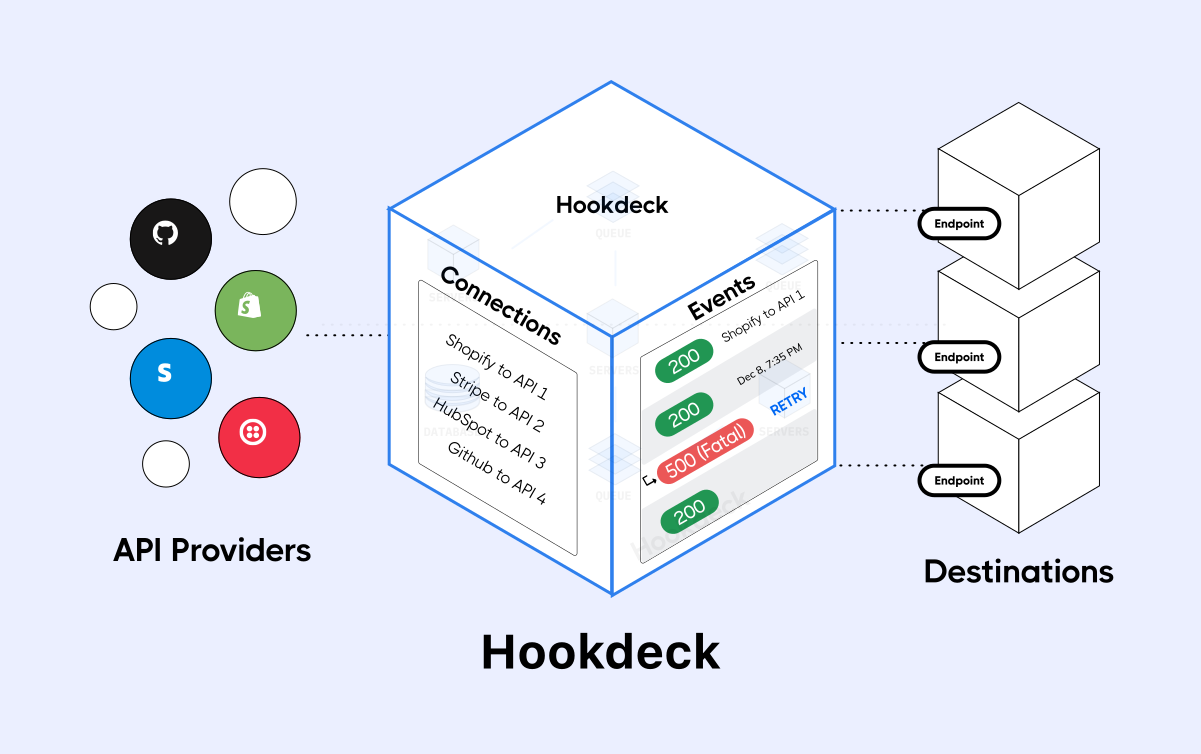
1. Ingestion. Events arrive via HTTP from external providers, internal services, or async API endpoints. The gateway provides stable, dedicated endpoints for each source. Events are acknowledged immediately — the producer receives a 200 response and moves on.
2. Verification. Before an event enters the pipeline, its authenticity is validated using the source's authentication scheme — HMAC signatures, API keys, bearer tokens, or provider-specific handshakes. Events that fail verification are rejected.
3. Queueing. Verified events are persisted to durable storage. This is the custody handoff — from this point, the gateway guarantees the event won't be lost regardless of what happens downstream. The queue absorbs traffic spikes and decouples ingestion from processing.
4. Filtering and transformation. Events pass through filter rules that evaluate their content against destination-specific criteria. Events that don't match are suppressed. Events that pass are transformed — payloads restructured, fields renamed, formats converted — so destinations receive data in the shape they expect.
5. Routing. Routing rules determine which events reach which destinations. A single event can fan out to multiple services. Routing is configured at the platform level, not coded into your application.
6. Delivery. Events are pushed to destination HTTP endpoints. The gateway tracks each delivery attempt. If a destination returns an error or is unreachable, the event is queued for retry with configurable backoff.
7. Retry and recovery. Failed deliveries are retried automatically. Persistently failing events surface as trackable issues with full context — the payload, the destination, the error response, and the delivery history. Bulk replay recovers from extended outages.
8. Observability. Every stage is instrumented. Teams can search for any event and see its complete lifecycle — from ingestion through delivery — in a single view. Alerts notify the team when delivery failures or anomalies exceed thresholds.
At present, event gateways focus on HTTP I/O because HTTP is ubiquitous — events are ingested and delivered via HTTP, making the gateway compatible with the widest range of event sources and destinations without custom development. As the category evolves, expect support for additional transports, event protocols, and formats.
Getting Started with an Event Gateway
Hookdeck Event Gateway is built to make event-driven application architectures reliable, secure, and observable. It provides managed ingestion, source verification for 160+ providers, filtering, transformation, routing, delivery with automatic retry and replay, and end-to-end event lifecycle visibility.
To understand how the event gateway category emerged and the problems that drove its creation, read the introduction to event gateways.
To see how event gateways compare across platforms — including cloud-native options like AWS API Gateway + Amazon EventBridge, Azure Event Grid + Azure Functions, and Google Eventarc — read the event gateway comparison guide.
To explore how an event gateway helps you overcome specific EDA challenges like filtering, routing, transformation, and third-party orchestration, see Overcoming Event-Driven Architecture Complexity with an Event Gateway.
For a guide to choosing between event gateways, message brokers, event meshes, and other EDA infrastructure, see Navigating Event-Driven Architecture: A Guide to Choosing the Right Infrastructure.
Webhook infrastructure, managed for you
Hookdeck handles ingestion, delivery, observability, and error recovery — so you don't have to.